
Static Electricity in Rail Car Loading: Hazards, Regulations, and How to Protect Fill Stations

Rail car loading operations move large volumes of flammable liquids every day. Crude oil, gasoline, ethanol, solvents, and jet fuel all flow through loading racks at high speed. That movement generates static electricity. The rail car tank shell acts as a conductor, and without a proper connection to earth ground, the shell can accumulate dangerous levels of electrical charge.
Terminal safety managers at petroleum distribution facilities often assume that steel wheels on steel rails provide a ground path. NFPA 77 addresses the wheel-to-rail assumption directly and rejects it. This guide explains how static electricity builds up at rail car fill stations, what the regulations require, and what verified ground monitoring looks like in practice.
How Static Electricity Accumulates During Rail Car Fill Station Operations
Three factors drive static electricity risk at rail car fill stations: the electrical properties of flammable liquids, the physical design of rail car tanks, and the conditions at outdoor loading racks. Each factor compounds the others. How they interact explains why rail car loading requires active, continuous grounding rather than a simple wire-and-clamp connection.
How Liquid Flow Generates Electrostatic Charge
Flammable liquids are poor electrical conductors. As petroleum products, solvents, and ethanol flow through pipes and loading arms into a tank shell, friction between the liquid and the pipe walls creates electrostatic charge. The charge separation process is called the triboelectric effect.
Rail car tanks can hold up to 34,500 gallons, with most modern flammable liquid cars holding around 28,600 gallons. High-speed pumping pushes thousands of gallons per minute through the loading system. Charge builds faster than it can naturally dissipate. Without a verified ground path, voltage on the tank shell can exceed safe thresholds before operators detect the problem.
Petroleum vapors ignite at very low energy levels. NFPA 77 notes that the minimum ignition energy for many petroleum vapors is approximately 0.25 millijoules. A static spark too small for a person to feel or notice can be enough to ignite vapor near an open dome hatch.
Why the Rail Car Tank Shell Is a Risk Point
The steel tank shell of a rail car acts as a conductor. Charge accumulates on the shell’s surface. If the shell is not connected to earth ground, the tank shell becomes an isolated charged body capable of releasing a spark when a loading arm or nozzle approaches.
The dome hatch area is a critical point. Opening the hatch exposes the interior of the tank and allows vapors to escape into the surrounding area. Any spark at that moment creates an ignition risk.
How Weather Conditions Affect Risk
Cold, dry conditions increase static buildup during loading operations. Low humidity means less moisture in the air to bleed off accumulated charge. The same loading operation carries higher ignition risk in dry winter conditions than in a humid environment. Terminal operators should account for seasonal factors when reviewing grounding procedures.
Why Steel Wheels on Steel Tracks Cannot Be Relied On for Static Grounding

The belief that steel wheels ground a rail car is one of the most common misconceptions at rail car fill stations. Many operators assume that a steel rail car sitting on steel tracks is automatically grounded. The logic seems sound: steel conducts electricity, and the tracks connect to the ground.
In practice, wheel-to-rail contact is not a reliable ground path. Modern rail car wheel assemblies use nonconductive bearing materials, lubricants, and wear pads between the wheel and axle. These components interrupt the electrical path. Even where some conductivity exists between the wheel and the rail, resistance may be far above the 10-ohm threshold required by NFPA 77. The connection cannot be counted on.
NFPA 77’s railroad tank car guidance addresses the wheel-to-rail misconception directly. The standard states that rail car wheels should not be relied upon for static grounding. A dedicated grounding connection is required for each loading operation.
The Association of American Railroads Casualty Prevention Circular CPC-1245 reinforces this requirement. Section 1.7 of the circular specifies that tank car tanks containing flammable or combustible gases or liquids should be electrically grounded and bonded during all loading and unloading operations.
A dedicated grounding connection means a grounding cable attached directly to a designated bare metal point on the rail car tank shell or structural metal. Verified resistance measurement is the foundation of a compliant grounding program at any rail car fill station.
Bonding and Grounding for Rail Car Loading: What Each Does and Why Both Are Necessary
Bonding and grounding are related but serve different purposes. The difference matters for terminal safety managers building a grounding program that meets regulatory requirements.
| Method | Purpose | Applied Before | Risk If Omitted |
| Bonding | Equalizes electrical potential between the loading rack and the rail car | Product flow and hatch opening | Spark discharge when metal parts at different charge levels come into proximity |
| Grounding | Connects the bonded system to earth so accumulated charge dissipates safely | Product flow and throughout the entire transfer | System remains isolated from earth and can discharge dangerously relative to surrounding structures or personnel |
NFPA 77 specifies that resistance to ground from fixed metallic objects should not exceed 10 ohms. Above this threshold, charge dissipation is too slow to prevent dangerous buildup during loading operations. The rail car tank shell and all connected loading equipment must meet this threshold before product begins to flow and throughout every transfer.
Why Passive Bonding Cables Are Not Sufficient and What Verified Monitoring Provides
Most rail car loading terminals rely on passive bonding cables as their primary static control measure. A passive cable is a wire with a clamp at each end. A passive cable connects the rail car to the loading rack or a ground point, and that is all it does. Passive cables provide no feedback, no monitoring, and no automatic response when a connection fails.
Rail yards are demanding environments. Passive cables fail in ways that are invisible to operators:
- Grounding cables get dragged across gravel and rail yard surfaces, wearing through the cable jacket
- Clamps get dropped and damaged, reducing jaw tension and contact reliability
- Cable jackets crack in cold weather, exposing conductors to corrosion
- A clamp may appear properly attached and still fail to make reliable metal-to-metal contact on a painted or corroded rail car surface
Passive cables also produce no documentation. NFPA 77, API RP 2003, and OSHA 29 CFR 1910.106 require that grounding practices be documented. A passive cable cannot satisfy that requirement. The regulatory standard calls for verified grounding, not assumed grounding.
An active ground monitoring system, like the STS 300 Ground Monitoring System, continuously measures resistance from the moment the grounding clamp is attached through the entire loading operation. The STS 300 confirms that the ground path stays below 10 ohms throughout each transfer. If the clamp detaches or resistance rises above the threshold, the STS 300 signals the condition and has the ability to immediately and stop product flow.
Visual indicators make grounding status clear to operators at all times. A green light confirms a verified ground path. A red light signals a problem. Operators do not need separate test instruments to confirm status during active loading.
Retractable cable reels extend up to 100 feet to reach rail car grounding attachment points at busy terminal loading racks. The spring-loaded mechanism keeps cables coiled when not in use and reduces trip hazards on active loading racks.
Grounding and Bonding Standards for Rail Car Loading Operations
Three standards form the core regulatory framework for static control at rail car fill stations.
StandardScopeKey Requirement for Rail Car LoadingNFPA 77: Recommended Practice on Static ElectricityPrimary standard for static control in industrial operationsEstablishes the 10-ohm resistance threshold, warns against relying on wheel-to-rail contact, and requires documentation of grounding practices and inspection intervalsAPI RP 2003: Protection Against Ignitions Arising Out of Static, Lightning, and Stray CurrentsPetroleum industry standard for static control during bulk liquid transfersCovers rail car operations at refineries and distribution terminals; frequently referenced alongside NFPA 77 in facility safety programsAAR CPC-1245: Casualty Prevention CircularRail industry guidance for the safe loading and unloading of non-pressure and pressure tank carsSection 1.7 requires that tank car tanks containing flammable or combustible gases or liquids be electrically grounded and bonded during all loading and unloading operations
Together, NFPA 77, API RP 2003, and CPC-1245 define what verified, documented grounding looks like at a compliant rail car fill station.
Environmental and Operational Factors That Shape Static Control Requirements
Rail car loading racks operate in conditions that create additional static control challenges beyond the basic hazard of flammable liquid transfer. The method of loading and the physical environment at the terminal both affect how static charge accumulates, where grounding cables are routed, and what performance the grounding equipment must deliver year-round.
Top Loading vs. Bottom Loading Operations
Top loading introduces product through the dome hatch at the top of the tank car. Top loading creates the highest vapor exposure risk at the point of loading arm entry. Vapors escape from the open hatch throughout the operation. Bottom loading introduces product from below, which reduces vapor escape at the hatch. The grounding requirement is the same for both methods. The attachment point for the grounding clamp may differ based on car design and loading configuration.
Outdoor Terminal Environments and Seasonal Risk
Rail car loading racks are almost always outdoor installations. Temperature extremes degrade cable flexibility, reduce clamp jaw tension, and weaken ground rod contact. Below-freezing temperatures make cable jackets brittle and clamp jaws stiffer. Terminals require equipment rated for the full operating temperature range to maintain year-round protection. The K78160A Grounding Clamp is built for demanding outdoor environments. Its hard-wearing teeth penetrate paint and corrosion to maintain reliable metal-to-metal contact on rail car surfaces. Where a non-sparking clamp is preferred, the G40 bronze grounding clamp is cast from bronze with two stainless steel contact points and is rated by STS for railcars, tanker trucks and barges.
Common Questions About Static Grounding at Rail Car Fill Stations
Terminal safety managers, loading rack supervisors, and compliance teams regularly ask the same questions when evaluating static grounding programs for rail car fill stations. The answers below address the most common points of confusion, from the wheel-to-rail misconception to the practical differences between bonding and grounding.
Do steel rail car wheels provide a ground path?
No. NFPA 77’s railroad tank car guidance states that wheel-to-rail contact cannot be relied upon for static grounding. Nonconductive bearing materials and lubricants in modern wheel assemblies interrupt the electrical path. A dedicated grounding cable attached to a bare metal point on the rail car tank shell is required for each loading operation.
When during the loading sequence should the grounding clamp be attached?
Operators should attach the grounding clamp before opening dome hatches and before starting product flow. The monitoring system must confirm grounding throughout the entire loading operation. Removing the clamp before the loading arm is disconnected and hatches are closed creates an ignition risk from residual vapors.
What does NFPA 77 require for rail car loading operations?
NFPA 77 requires a dedicated grounding connection to each rail car during loading. The standard sets a resistance threshold of 10 ohms between the equipment and the earth ground point. NFPA 77 warns against relying on wheel-to-rail contact. The standard also requires documentation of grounding practices and inspection of grounding equipment at defined intervals.
What is a static accumulator liquid and why does it matter?
A static accumulator liquid is a poor electrical conductor. As a static accumulator liquid flows through pipes and loading equipment, the liquid builds up electrostatic charge faster than the flow process dissipates it. Petroleum products, solvents, ethanol, and jet fuel all fall into this category. A product’s static accumulator classification determines the grounding equipment and procedures a terminal must use.
How does active ground monitoring support compliance documentation?
Passive bonding cables create no record of grounding status during a loading operation. Active monitoring systems continuously measure and verify ground resistance throughout each transfer. Continuous resistance measurement creates a documented record that supports compliance requirements under NFPA 77 and OSHA 29 CFR 1910.106. Regulatory standards call for verified grounding, and active monitoring is what verification looks like in practice.
What is the difference between bonding and grounding at a rail car loading rack?
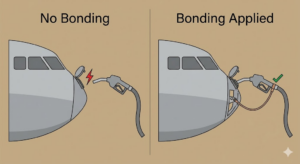
Bonding connects the loading rack and the rail car so they share the same electrical potential. Bonding prevents sparks when metal parts come close together during loading arm attachment or hatch opening. Grounding connects the bonded system to an earth ground point so accumulated charge has a safe path to dissipate. Both steps are required. Bonding without grounding still leaves the system isolated from earth, which creates ignition risk relative to surrounding structures and personnel.