

Static Grounding Standards Compared: NFPA 407 vs API RP 2003 vs NFPA 77
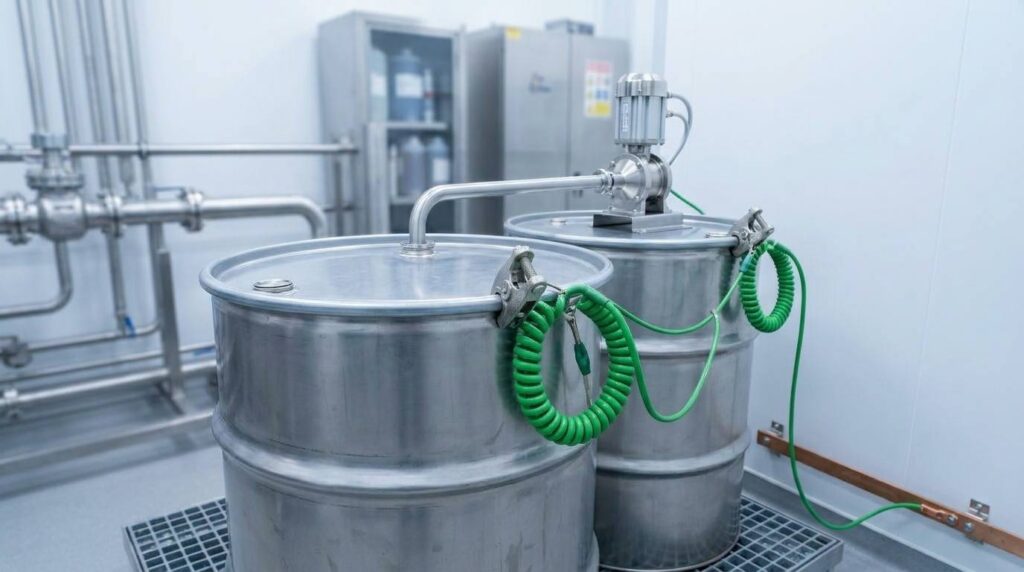
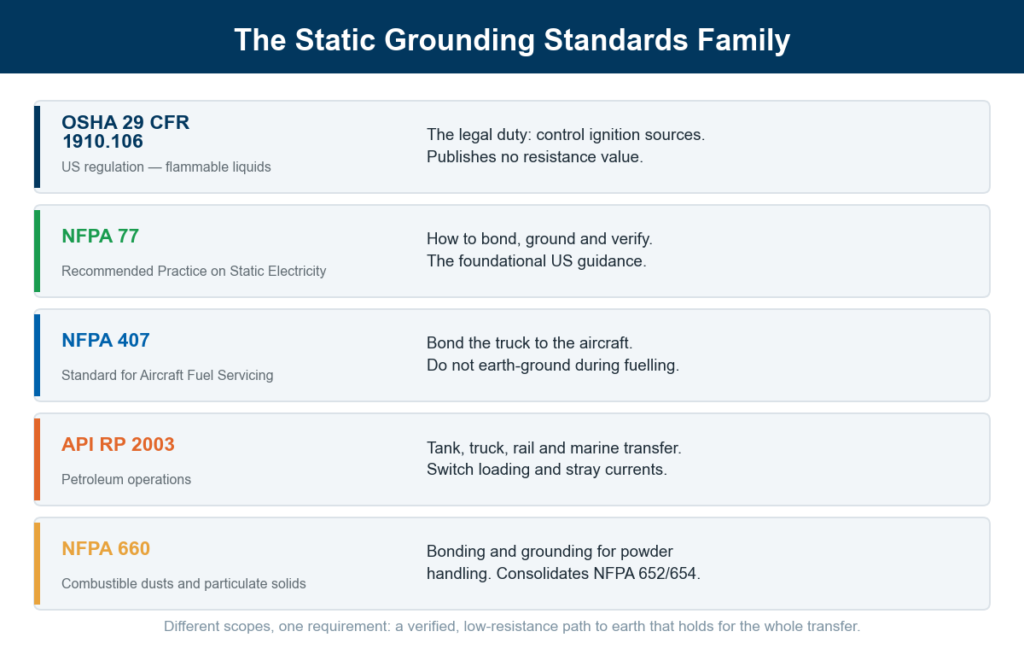
Three standards govern static grounding and bonding for most hazardous transfer operations in the United States, and they do not all ask for the same thing. NFPA 407 covers aircraft fuel servicing and does not allow the aircraft to be earth-grounded during fueling. API RP 2003 covers petroleum facilities, including switch loading, stray currents and lightning. NFPA 77 is the general recommended practice that sits underneath both. This page compares them side by side so you can see which one your operation is measured against.
This is educational guidance, not legal or compliance advice. Always work from the current published edition of any standard and consult your authority having jurisdiction.
NFPA 77 vs. NFPA 407 vs. API RP 2003 at a Glance
| NFPA 77 | NFPA 407 | API RP 2003 | |
|---|---|---|---|
| Full title | Recommended Practice on Static Electricity | Standard for Aircraft Fuel Servicing | Protection Against Ignitions Arising Out of Static, Lightning, and Stray Currents |
| Published by | NFPA | NFPA | American Petroleum Institute |
| Document type | Recommended practice (advisory) | Standard (mandatory language) | Recommended practice (advisory) |
| Scope | Static hazards in any industry: liquids, powders, gases and people | Fueling aircraft, plus the refuelers, hydrant systems and airport fuel facilities that supply them | Petroleum facilities: loading racks, storage tanks, rail and marine transfer |
| Earth grounding | Bond and ground | Bond the aircraft to the fueling vehicle; do not earth-ground the aircraft | Bond and ground, plus control of stray and lightning currents |
| Signature topics | How charge is generated; resistance thresholds for bonding and dissipation | The bonding sequence: connect first, disconnect last | Switch loading, fill velocity, relaxation time, stray currents |
| Typical sites | Chemical plants, drum and tote filling, powder handling | Airport ramps, fuel farms, refueler fill stands | Terminals, refineries, rail spurs, marine docks |
Which Standard Applies to Your Operation?
Most sites answer to more than one document. The table shows where to start.
| Operation | Primary standard | Also relevant |
|---|---|---|
| Fueling aircraft from a refueler or hydrant cart | NFPA 407 | Airport operator and insurer requirements |
| Loading refuelers at an airport fill stand | NFPA 407 | NFPA 77 |
| Tank truck loading at a terminal rack | API RP 2003 | NFPA 77, OSHA 1910.106 |
| Rail car loading | API RP 2003 | NFPA 77 |
| Marine terminal transfer | API RP 2003 | NFPA 77 |
| Vacuum truck operations | API RP 2219 (references API RP 2003) | NFPA 77 |
| Drum, tote and container filling of flammable liquids | NFPA 77 | NFPA 30, OSHA 1910.106 |
| Powder and dust handling | NFPA 660 | NFPA 77 |
If your work is general flammable-liquid handling, the detail you need is in our guide to static grounding requirements for flammable liquids, which covers NFPA 77, NFPA 30, OSHA 1910.106, liquid classes and resistance values in depth. The rest of this page concentrates on the two standards that guide does not cover: NFPA 407 and API RP 2003.
NFPA 407: Grounding and Bonding for Aircraft Fueling
Aviation is the case where the intuitive answer is the wrong one.
NFPA 407 requires bonding between the fuel servicing vehicle and the aircraft, and it prohibits earth grounding of the aircraft during fueling. Research found that once an aircraft and fuel truck are properly bonded to one another, a separate earth ground carries no meaningful charge and adds no protection. What it does add is an arcing risk at the moment the cable is connected or disconnected, potentially near open fuel vents.
Unlike NFPA 77, NFPA 407 is a standard, written in mandatory language and widely adopted by reference into airport operating requirements and insurer conditions.
The NFPA 407 Bonding Sequence
The protection NFPA 407 relies on is the bond, so the order of operations matters:
- Bond first. Connect the fuel servicing vehicle or hydrant cart to the aircraft before any fill cap is opened or any nozzle approaches the fill point.
- Bond the nozzle for overwing fueling. On overwing (open-port) fueling, the nozzle is bonded to the aircraft before the fill cap is removed.
- Hold the bond for the whole transfer. The connection stays in place until fueling is complete and the fill cap is back on.
- Disconnect last. The bond is the final connection removed, after the nozzle and hose are clear.
Underwing (single-point) pressure fueling follows the same rule: the vehicle-to-aircraft bond is made before the coupling is connected and removed after it is disconnected.
What Resistance Does an Aircraft Fueling Bond Need?
NFPA 407 caps the resistance between the bonding cable clip and the fueling system framework at 25 ohms. That is a far tighter test than the dissipation figure in NFPA 77, because the bond has to equalize potential between the aircraft and the vehicle at the nozzle, not just bleed charge away slowly. A visual check will not find a cable that has parted inside its jacket or a clamp sitting on paint; a resistance check, or a system that monitors the bond continuously, will.
NFPA 407 Beyond the Aircraft: Fuel Farms and Fill Stands
NFPA 407 also reaches back up the supply chain to the airport fuel facilities that load the refuelers. At a fill stand, the refueler is bonded to the loading piping before the dome is opened (top loading) or before any fuel connection is made (bottom loading), and the bond stays in place until loading is finished. Because the same trucks connect and disconnect many times a shift, this is where an unverified bond is most likely to fail without anyone noticing.
STS builds grounding and bonding equipment for this application. See jet fuel fill station grounding systems, or the detailed guide to static electricity in aviation fueling.
API RP 2003: Static, Lightning and Stray Currents in Petroleum Operations
API RP 2003 is the petroleum industry’s counterpart to NFPA 77. It addresses the same physics but is written around the operations petroleum facilities actually run: tank filling, truck and rail loading, marine transfer, switch loading and tank cleaning. It also covers two ignition sources NFPA 77 treats only lightly: lightning and stray currents.
Switch Loading: Why It Is the Highest-Risk Load
Switch loading means loading a low-vapor-pressure product, such as diesel or heating oil, into a compartment that last carried a high-vapor-pressure product such as gasoline.
On their own, neither product is the main problem. Gasoline vapor in a closed compartment is usually too rich to ignite, and diesel gives off too little vapor at normal temperatures. Mix the two and the vapor space can fall squarely inside the flammable range. At the same time, diesel is a low-conductivity liquid that holds charge well, so the incoming product generates static in a compartment that may now contain an ignitable atmosphere.
API RP 2003, and the tank vehicle loading table that NFPA 77 bases on it, set out the controls for this situation:
- Bond before anything else. The truck is bonded to the fill system before loading starts. Ground indicators interlocked with the loading system are commonly used to confirm the bond is in place.
- Slow the start of the fill. Inlet velocity is held below 1 m/s (about 3 ft/s) until the inlet into the compartment is covered by liquid to a depth of two fill-pipe diameters.
- Allow relaxation time. Product leaving a microfilter carries a high charge, so at least 30 seconds of residence time is provided between any microfilter or strainer and the tank truck inlet.
- No splash filling. Fill pipes reach the bottom of the compartment, or the truck is bottom-loaded.
- Nothing conductive into the compartment. Gauging tapes, sample cans and thermometers stay out of the dome or hatch during loading and for at least 1 minute afterward, so an ungrounded object cannot become a spark gap. Gauging through a bonded gauge well can be done at any time.
Stray Currents and Lightning
Cathodic protection systems, welding returns, electric rail systems and induced currents can put current onto piping and equipment that has nothing to do with static, and bonding alone does not always solve it. API RP 2003 addresses where insulating flanges and insulating joints belong, where bonding across them is needed, and how storage tanks are protected against lightning. This is one reason petroleum loading rack designs look different from a general-industry drum-filling station.
Where API RP 2003 Applies
It is the reference to reach for at petroleum refining, oil rig, rail car loading and marine terminal operations. Vacuum truck work falls under API RP 2219, which points back to API RP 2003 for static protection; see vacuum truck grounding systems. For a worked example at the rack, see how to ground a tanker truck.
Where NFPA 77 Fits
NFPA 77 is the general recommended practice that both of the documents above build on. It explains how static charge is generated and accumulates, and it sets out the two resistance thresholds the rest of the industry quotes: about 10 ohms or less for a sound metal-to-metal bond, and up to 1 megohm for dissipating static charge. NFPA 407 and API RP 2003 apply that physics to their own operations and add the procedures specific to them.
We cover NFPA 77 in detail, together with NFPA 30 and OSHA 1910.106, in the flammable liquids grounding requirements guide.
Combustible Dust: NFPA 652, NFPA 654 and the Move to NFPA 660
Powders and particulate solids generate static too, and a dust deflagration does not need a liquid anywhere in the process. Bonding and grounding requirements for dust handling have historically sat in NFPA 652 (fundamentals) and NFPA 654 (particulate solids processing), alongside commodity-specific standards for agricultural dust, metals and wood.
NFPA has consolidated that family into a single combustible dust standard, NFPA 660. If your dust hazard analysis or internal procedures still cite 652 and 654 by number, confirm which edition your AHJ and insurer are working from before your next review.
The grounding principle does not change. Conductive equipment in a dust handling train (hoppers, chutes, flexible connections, drums, filter housings, and the operator) needs to be bonded and grounded so charge cannot accumulate on an isolated conductor. See grain and powder processing and food and beverage applications.
Is Static Grounding Required by Law?
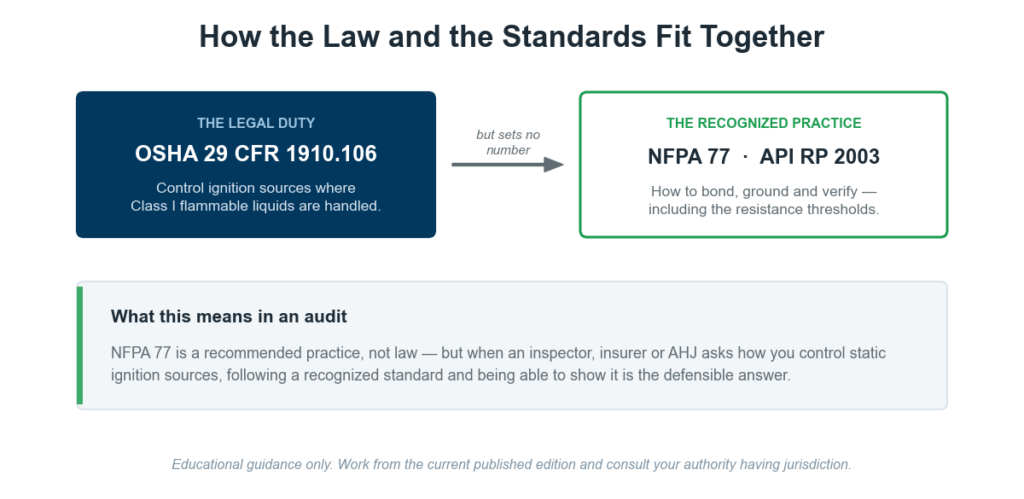
In the United States, the binding requirement comes from OSHA rather than from NFPA or API. 29 CFR 1910.106 requires employers to control ignition sources where flammable liquids are handled, and static electricity is one of those sources. It mandates bonding in specific cases, such as 29 CFR 1910.106(e)(6)(ii) for containers during dispensing, but it does not define what resistance counts as a compliant connection.
That gap is what the consensus standards fill. When an inspector, insurer or auditor asks how you control static ignition, the defensible answer is that you follow a recognized practice (NFPA 407 for aviation, API RP 2003 for petroleum, NFPA 77 elsewhere) and can show that you do.
What These Standards Require of a Static Grounding System
Read together, the three standards converge on five things a grounding system has to do.
| Requirement | What it means in equipment terms |
|---|---|
| A defined resistance setpoint | The system judges the connection against a stated threshold, not against “the clamp is attached” |
| Continuous verification | The path is checked throughout the transfer, not once at hookup |
| Hazardous area rating | Enclosure and circuits rated for the classified area they sit in |
| Interlock or shutdown | Loss of a compliant ground stops the pump or closes the valve without operator intervention |
| Clear indication and record | Unambiguous operator status, and an output that can feed a control system or audit trail |
A passive cable and clamp satisfies the first half of the first row and none of the rest.
How STS Systems Meet These Standards
The STS 300 ground monitoring system was designed against that list. It verifies the ground path continuously against a resistance setpoint rather than confirming a connection once, drives a permissive interlock so pumping stops the moment a compliant ground is lost, is built for hazardous locations, and gives the operator unambiguous green/red indication with dry contacts for the control system.
If you are choosing between systems, the buyer’s comparison in our guide to static ground monitoring systems for flammable and combustible materials walks through what separates a dependable system from a false sense of security.
Frequently Asked Questions
What is NFPA 407?
NFPA 407 is the Standard for Aircraft Fuel Servicing. It covers how aircraft are fueled and defueled, the fuel servicing vehicles and hydrant systems used to do it, and the airport fuel facilities that supply them. For static control, its core requirement is a bond between the fueling vehicle and the aircraft that is made first and broken last.
Should an aircraft be grounded during refueling?
No. NFPA 407 requires bonding between the fuel servicing vehicle and the aircraft and prohibits earth grounding of the aircraft during fueling, because a separate earth ground adds arcing risk without adding protection once the bond is in place.
What is API RP 2003?
API RP 2003 is the American Petroleum Institute’s recommended practice on Protection Against Ignitions Arising Out of Static, Lightning, and Stray Currents. It is the petroleum industry’s equivalent of NFPA 77, written around loading racks, storage tanks, rail and marine transfer.
What is switch loading, and why is it dangerous?
Switch loading is loading a low-vapor-pressure product such as diesel into a compartment that previously held gasoline. The leftover gasoline vapor can bring the compartment into the flammable range, while the low-conductivity diesel generates and holds static charge. API RP 2003 controls it with bonding before loading starts, a slow start below 1 m/s, at least 30 seconds of relaxation time after filters and no splash filling.
What is the difference between NFPA 77 and API RP 2003?
Both are recommended practices on static electricity. NFPA 77 is general and applies across industries, including powders and chemicals. API RP 2003 is specific to petroleum facilities and adds guidance NFPA 77 does not dwell on, such as switch loading procedures, stray currents and lightning protection for tanks.
Which standard applies to tank truck loading?
At a petroleum terminal, API RP 2003 is the primary reference, with NFPA 77 supplying the underlying practice and OSHA 1910.106 the legal duty. Refuelers loaded at an airport fill stand fall under NFPA 407.
Standards References
- NFPA 407, Standard for Aircraft Fuel Servicing
- API RP 2003, Protection Against Ignitions Arising Out of Static, Lightning, and Stray Currents
- NFPA 77, Recommended Practice on Static Electricity
- API RP 2219, Safe Operation of Vacuum Trucks in Petroleum Service
- NFPA 660, Standard for Combustible Dusts and Particulate Solids
- OSHA 29 CFR 1910.106, Flammable Liquids
Not Sure Which Standard Applies to Your Operation?
STS has built static ground monitoring equipment in the United States since 1976, for operations working to every standard on this page. Tell us what you transfer and how, and we will tell you what the applicable standard expects of the equipment. Request a quote or contact us.