

Static Grounding Requirements for Flammable Liquids: What NFPA 77, OSHA, and NFPA 30 Require
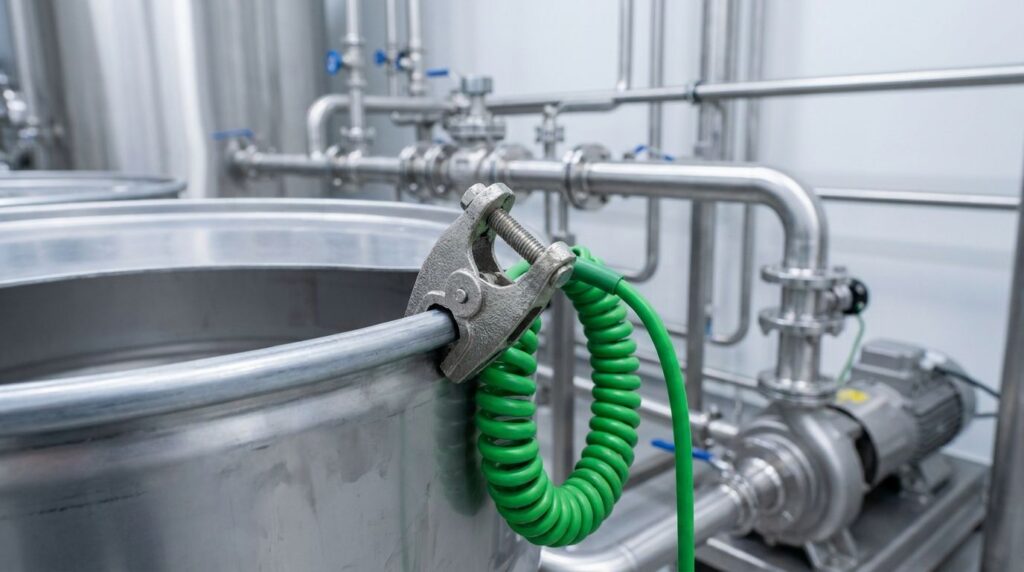
Grounding and bonding are required whenever flammable liquids are transferred. The flow of liquid generates static electricity, and if that charge builds up and discharges as a spark, it can ignite the vapors.
In the United States, OSHA 29 CFR 1910.106 sets the duty to control ignition sources, and the practices in NFPA 77 and NFPA 30 define how to meet it. Compliance comes down to one thing: a verified, low-resistance path to ground that holds for the entire transfer, not just at hookup.
| Standard | What it covers | What it requires |
| OSHA 29 CFR 1910.106 | Flammable liquids (US regulation) | Control ignition sources, including static; minimize static generation |
| NFPA 77 | Recommended Practice on Static Electricity | How to bond, ground, and verify an adequate connection |
| NFPA 30 | Flammable and Combustible Liquids Code | Static precautions and bonding/grounding for storage, handling, and transfer |
What Does OSHA Require for Grounding and Bonding Flammable Liquids?
OSHA 1910.106 does not publish a grounding number or a stand-alone “bond and ground” rule. It requires facilities to control ignition sources when they handle Class I flammable liquids (1910.106(b)(6)), and it treats static electricity as one of those sources.
The standard’s one direct static reference requires fill pipes to be designed so they minimize static generation (1910.106(b)(2)(viii)(e)). For the actual method of control, OSHA relies on recognized practices, which is where NFPA 77 and NFPA 30 come in.
In practice, that means bonding and grounding transfer equipment and being able to show the connection was verified, not assumed. Inspectors and insurers treat a missing or unverified ground as an ignition-control failure.
What Does NFPA 77 Require for Static Electricity Control?
NFPA 77, Recommended Practice on Static Electricity, is the reference for identifying and controlling static hazards during liquid handling. It is a recommended practice rather than a code, but OSHA and insurers treat it as the accepted method for meeting the duty to control static ignition.
NFPA 77 explains how charge accumulates during flow, splash filling, and agitation, and it establishes bonding and grounding as the primary controls.
It also defines what an adequate connection is: a conductive path to ground with low enough resistance to dissipate charge as fast as it builds. Because that adequacy has to be maintained, NFPA 77 supports continuous verification during a transfer rather than a single check at hookup.
What Does NFPA 30 Add for Flammable and Combustible Liquids?
NFPA 30, the Flammable and Combustible Liquids Code, governs how these liquids are stored, handled, and transferred. It calls for precautions against static ignition wherever a charge could ignite a flammable atmosphere.
Where NFPA 77 explains the science and practice, NFPA 30 sets the code framework for the operations, and it points to bonding and grounding, consistent with NFPA 77, as the control.
NFPA 30 also classifies liquids by flash point, which determines when grounding is mandatory versus advisable. For US facilities, meeting NFPA 30 alongside OSHA 1910.106 is the baseline auditors and insurers expect.
Do Combustible Liquids Need to Be Grounded, or Only Flammable Liquids?
Yes, combustible liquids can require grounding too. The dividing line is flash point.
| Class | Type | Flash point | Grounding during transfer |
| Class I (IA/IB/IC) | Flammable | Below 100 F | Expected |
| Class II | Combustible | 100 F to below 140 F | When handled at/above flash point, or if charge can accumulate |
| Class IIIA | Combustible | 140 F to below 200 F | Same condition |
| Class IIIB | Combustible | 200 F and above | Same condition |
Flammable liquids (Class I) give off ignitable vapor at normal temperatures, so bonding and grounding during transfer is expected as a matter of course.
Combustible liquids still require grounding whenever they are handled at or above their flash point, or when the operation can build a static charge, such as during high-velocity pumping, filtering, or splash filling.
The rule most facilities follow is simple: bond and ground any transfer that could produce an ignitable atmosphere. Static electricity does not read the label, so the risk depends on the vapor and the charge, not the class alone.
What Resistance to Ground Is Required for a Compliant Connection?
Grounded needs a number, and this is where operations most often get it wrong, because there are two different thresholds serving two different purposes.
| Purpose | Threshold (NFPA 77) | What it means |
| Dissipating static to earth | Up to 1 megohm (1,000,000 ohms) | Even a modest conductive path drains a small static charge |
| Verifying a sound bonding connection | Below about 10 ohms (25 ohms for some metals) | A reading above roughly 10 ohms indicates a loose, corroded, or broken connection |
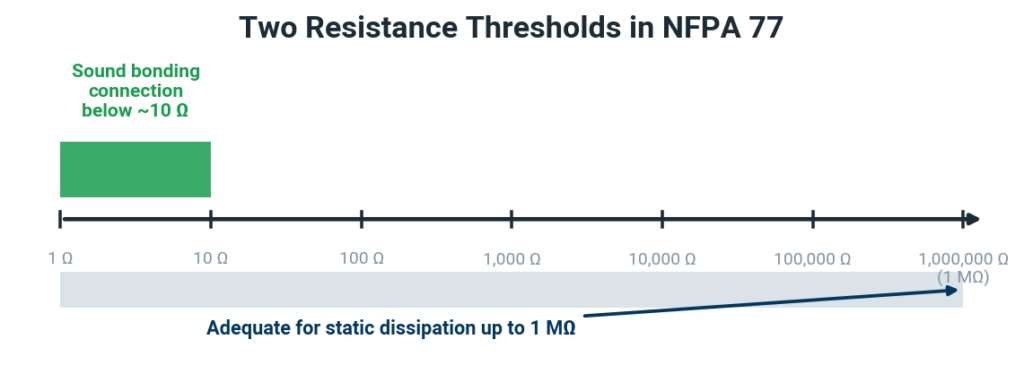
For static dissipation alone, a resistance as high as 1 megohm is adequate, because a static charge is small and drains through even a high-resistance path.
But because a reading above roughly 10 ohms signals a compromised connection, a reliable operation verifies against a low setpoint rather than the dissipation ceiling.
The STS 300, for example, uses a 5-ohm setpoint, stricter than NFPA 77’s 10-ohm threshold for a sound connection, so it flags a degrading ground before it reaches the standard’s limit.
The compliance point is not memorizing one number. It is proving the connection stays below the threshold for the entire transfer.
What Is the Difference Between Bonding and Grounding?
OSHA and NFPA treat bonding and grounding as two related but distinct controls, and a compliant operation usually needs both.
| Control | What it connects | What it prevents |
| Bonding | Two or more conductive objects to each other (for example, a fill nozzle to a receiving drum) | A voltage difference between them, so no spark can jump the gap |
| Grounding | The bonded system to earth | Charge buildup, by giving it a path to dissipate |
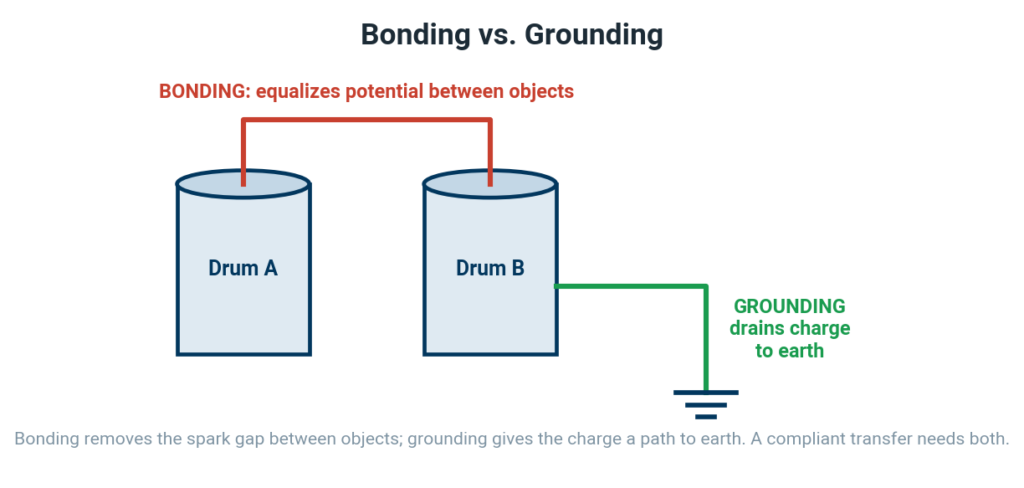
Bonding alone equalizes potential between objects. Grounding alone drains charge to earth. Together they prevent both the buildup and the discharge.
During a flammable-liquid transfer, equipment is bonded to remove differences in potential and grounded so the whole assembly stays at earth potential. Doing only one, or confusing the two, is a common compliance gap that inspectors specifically look for.
How Do You Verify and Document That Grounding Stays Compliant?
The requirement is not just to connect a ground, but to maintain and verify it. A clamp that tests fine at hookup can degrade mid-transfer from vibration, paint, corrosion, or residue, and a passive bonding cable gives no warning when it does.
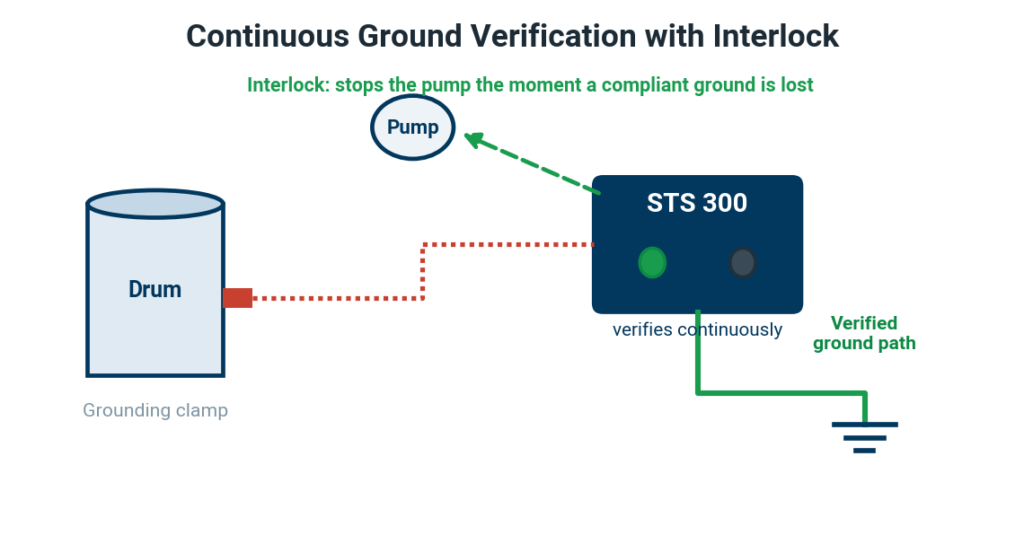
This is why NFPA 77 emphasizes a maintained, adequate connection, which points toward continuous verification rather than a start-of-cycle check. A static ground monitoring system such as the STS 300 does three things a passive cable cannot:
- Verifies continuously: it checks the resistance of the ground path for the whole transfer, not just at hookup.
- Interlocks the operation: it stops pumps or valves the moment a compliant ground cannot be confirmed.
- Supports your records: it gives operators a verified ground they can document as part of their transfer procedure, which supports the documentation auditors expect.
For a fuller buyer comparison, see our guide to choosing a static ground monitoring system.
Meeting the Requirements in Practice
Meeting NFPA 77, OSHA 1910.106, and NFPA 30 comes down to one thing: a verified, low-resistance path to ground that holds for the entire transfer.
Passive bonding proves nothing after hookup. A monitored, interlocked system proves it continuously and stops the operation if the ground fails.
These requirements apply wherever flammable or combustible liquid is transferred, from chemical processing and petroleum refining to rail car loading and marine terminals. For a step-by-step example, see how to ground a tanker truck.
Aviation fueling and petroleum loading racks also work to standards of their own. For those, see our comparison of NFPA 407, API RP 2003 and NFPA 77.
If you are specifying or auditing grounding for flammable or combustible liquid handling, see the STS 300 Ground Monitoring System or request a quote for your application.
Frequently Asked Questions
Is NFPA 77 mandatory or just a recommended practice?
NFPA 77 is a recommended practice, not a law. But OSHA relies on recognized practices to meet its general duty to control ignition sources, and insurers and auditors treat NFPA 77 as the accepted method. In practice, it is the standard you are held to.
Does OSHA specify a required grounding resistance?
No. OSHA 1910.106 requires that ignition sources be controlled but does not publish a resistance number. The accepted figure comes from NFPA 77, where an all-metal path above roughly 10 ohms indicates a compromised connection.
Do you need both bonding and grounding, or is one enough?
Usually both. Bonding equalizes the potential between objects so no spark jumps between them, and grounding drains the accumulated charge to earth. Doing only one leaves a gap that inspectors specifically look for.
What happens if the ground is lost during a transfer?
With a passive cable, nothing warns the operator, and charge can build until it discharges as a spark. A monitored system detects the loss immediately and interlocks the operation, stopping the pump before a charge can accumulate.
Standards References
- NFPA 77, Recommended Practice on Static Electricity
- OSHA 29 CFR 1910.106, Flammable Liquids
- NFPA 30, Flammable and Combustible Liquids Code
- NFPA 407 and API RP 2003: see static grounding standards for aircraft fueling and petroleum loading