

Static Ground Monitoring Systems for Flammable and Combustible Materials: How to Choose One That Won’t Fail Mid-Transfer

Static ground monitoring systems are the equipment that keeps a static spark from igniting flammable or combustible materials during transfer, and the reliable ones share three traits: they verify the ground connection continuously, they stop the operation automatically when that ground is lost, and they are rated for the hazardous location they sit in. If you are choosing one for a plant that handles flammable liquids, vapors, or combustible dust, the brand name matters less than whether the system does those three things. This guide explains what separates a dependable system from a false sense of security, and how to evaluate any option on the US market. If you’re ready to choose your monitoring system, request a quote from us.
Why Static Grounding Usually Fails, and It Is Not the Clamp
Most people assume that if the grounding clamp is attached, the equipment is grounded. That assumption is where incidents come from.
A grounding clamp only makes a physical connection. It cannot tell you whether that connection is still electrically sound five minutes into a transfer. Paint, rust, product residue, vibration, and a clamp that gets bumped loose all raise the resistance of a connection that looks perfect at hookup. With a simple bonding cable, nothing warns the operator. The first sign that the ground failed can be the spark itself.
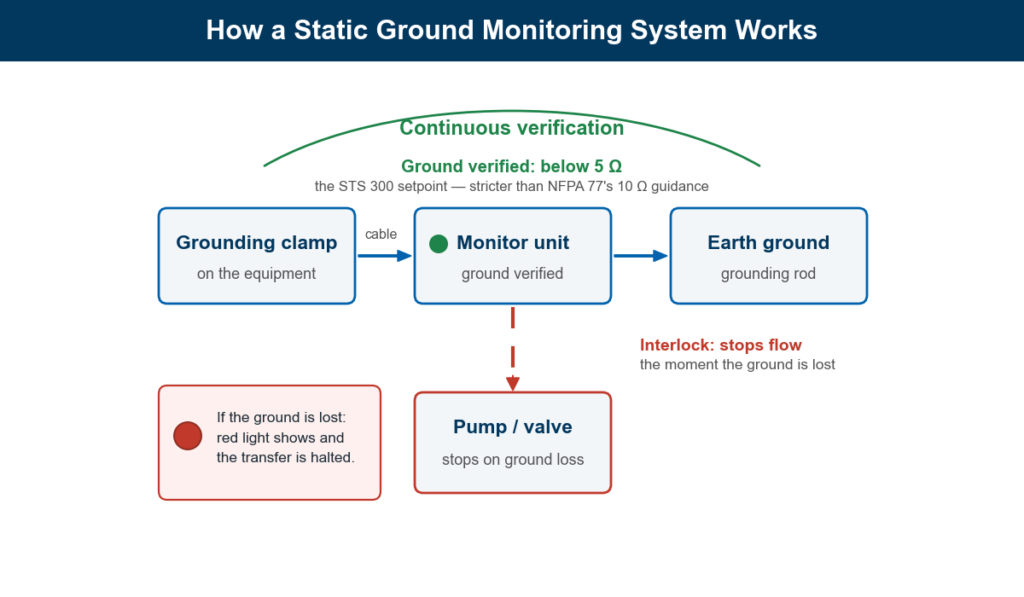
That is the real problem a static ground monitoring system solves. It connects, then watches that connection for the whole operation and acts the moment the ground is compromised (Figure 1).
What Ground Failure Actually Looks Like in the Field
We have seen both failure modes in the field.
At a bulk liquid transfer terminal in the Southeast, a team was offloading chemical rail cars with standard heavy-duty clamps, and the pre-transfer checks showed a secure connection. As the pumps reached full speed, continuous vibration through the piping and rail car chassis worked the clamp loose until it slipped off its contact point mid-transfer. A system that only checks the ground at the start of a cycle would have kept the pumps running in a hazardous state. Continuous loop monitoring caught the resistance spike the instant contact was lost and triggered the interlock, stopping the pumps within milliseconds.
At a large cabinetry manufacturing plant, our engineers watched a third-party contractor back an 18-wheeler up to the liquid waste area and begin bulk transfer of flammable solvent waste without anyone ever connecting the truck to the facility ground. Here the risk was not a degraded connection but a missing one. An intelligent interlock removes that human-error vector entirely: it verifies a low-resistance path to earth before the transfer pumps can energize, and if a valid ground is never established, or is lost mid-transfer, the operation cannot run.
What Makes a Static Ground Monitoring System Reliable
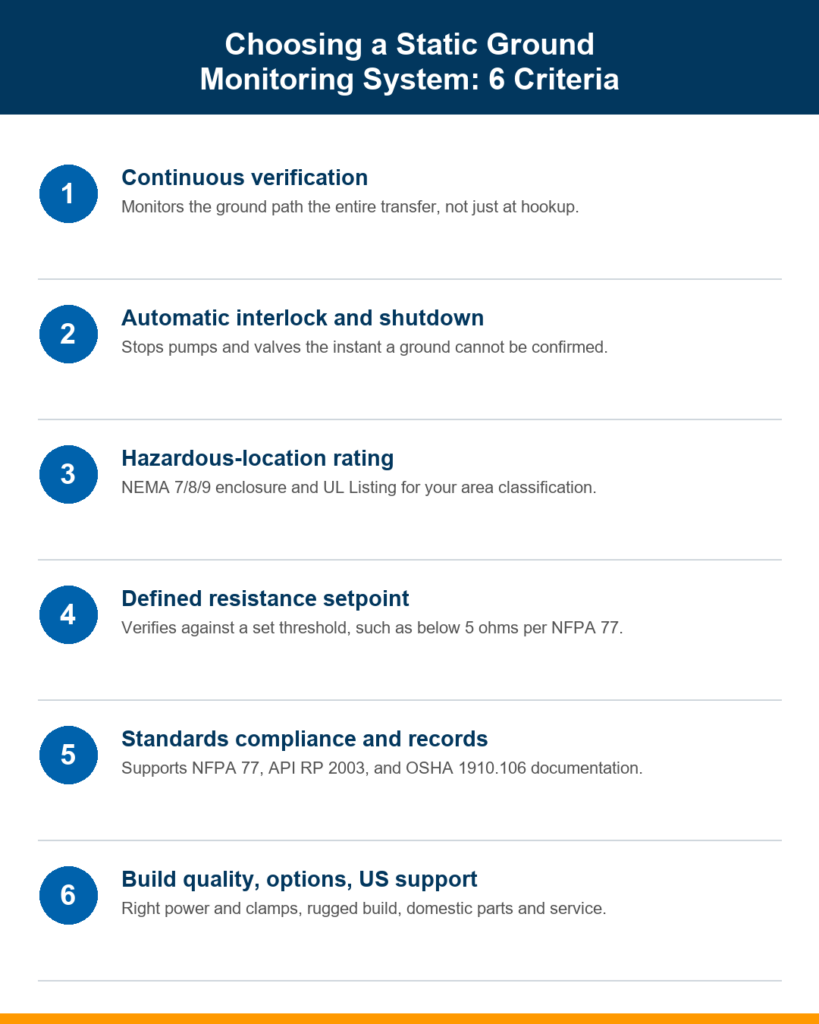
When buyers ask which system is best for flammable or combustible materials, they are really asking which system they can trust to work every time. Judge any system against the six criteria below (Figure 2).
Continuous Verification, Not a One-Time Check
A reliable system monitors the resistance of the ground path from the clamp to earth for the whole transfer, from the first hookup to the last drop. If that path degrades at any point, the system knows right away. A one-time indicator that only confirms the connection was made at hookup cannot tell you what happened during the operation itself.
Automatic Interlock and Shutdown
Verification is only useful if it can act. The system should provide relay contacts that tie into your process so it can stop pumps, close valves, or sound an alarm the instant a proper ground cannot be confirmed. This is what turns a warning light into real protection: the transfer physically cannot proceed without a verified connection to ground.
A Hazardous-Location Rating That Matches Your Area
Equipment installed where flammable vapors or combustible dust can be present must be built for it. Look for an explosion-proof enclosure and a UL Listing for your area classification (for example, Class I Division 1 Group D for flammable gases and vapors, and Class II Division 1 Groups E, F, and G for combustible dusts). Match the rating to your classified area under the National Electrical Code (NFPA 70).
A Defined Resistance Setpoint Tied to a Standard
“Grounded” needs a number. A dependable system verifies the connection against a specific low-resistance threshold, such as below 10 ohms per NFPA 77, rather than a vague indicator. Ask what the setpoint is and which standard it references, because a system that trips at a loose threshold offers little real protection.
Standards Compliance and Audit Readiness
The system should support the practices in NFPA 77 (static electricity), API RP 2003 (ignition prevention for petroleum facilities), and OSHA 29 CFR 1910.106 (flammable liquids). Vacuum-truck and tank operations also fall under API 2219. A monitored system also gives operators a verified ground they can document as part of their transfer procedure, which a passive cable cannot.
Build Quality, Options, and Support
Practical reliability also means the right power source for your site (multiple AC and DC options), the right clamp and cable for your equipment, a rugged enclosure, and a manufacturer that supports the product and stocks parts. For US facilities, a domestically made and supported system reduces lead time and downtime.
Passive Cable vs. Monitored System, at a Glance
A passive cable only makes contact. A monitored system verifies that contact and can stop the operation if it fails (Figure 3).
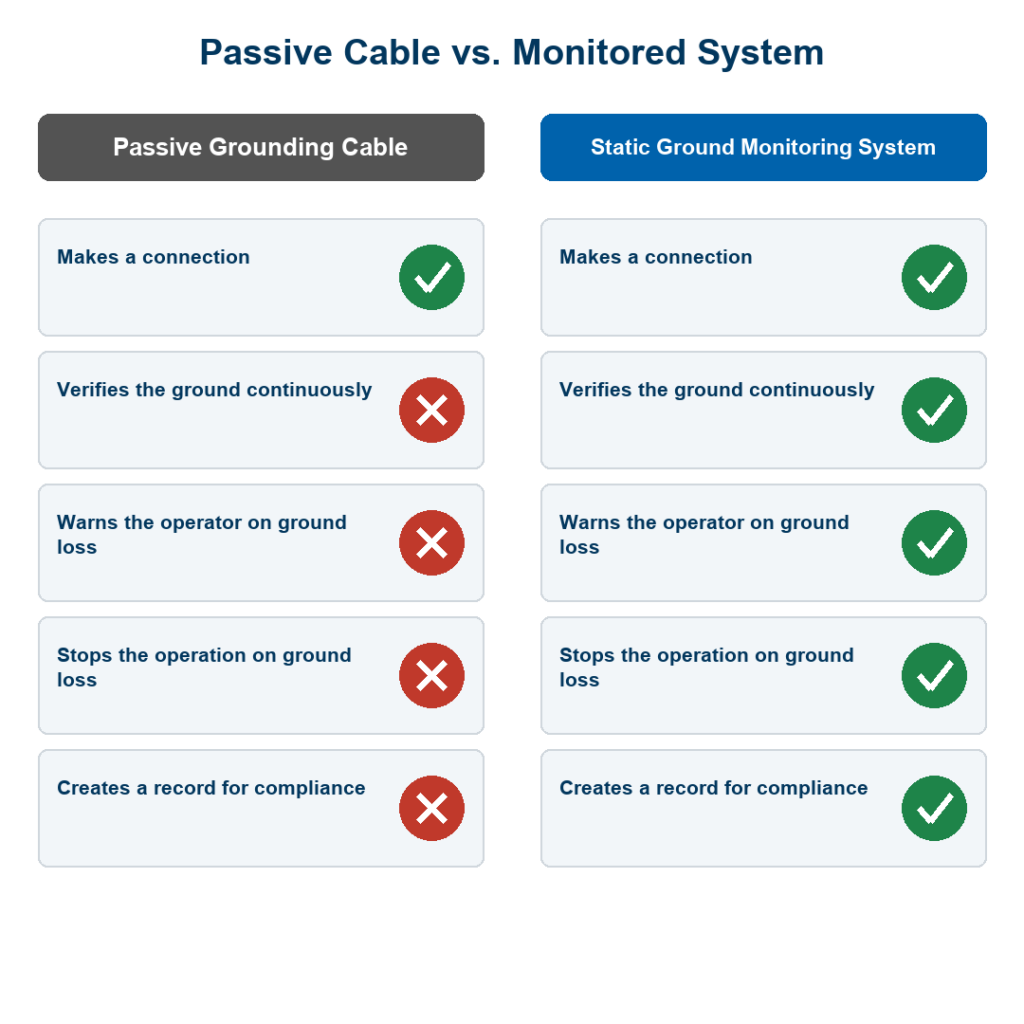
| Capability | Passive grounding clamp/cable | Monitored system (STS 300) |
|---|---|---|
| Confirms a genuine ground connection | No — contact is assumed | Yes — measures resistance continuously |
| Detects a lost/failed ground mid-transfer | No | Yes — alarms instantly |
| Resistance setpoint tied to a standard | No | Yes — defined setpoint per NFPA 77 (confirm STS 300’s exact Ω value) |
| Hazardous-area rating | Varies / often none | NEMA 7/8/9, Class I/II Div 1 |
| Automatic interlock / shutdown | No | Yes — halts transfer if ground is lost |
| Operator status indication | None | Visual + audible safe-ground indicator |
| Best suited for | Low-risk, non-critical | Flammable / combustible transfer |
The STS 300 is the monitored system above – learn more about our monitored system.
How to Evaluate a Static Ground Monitoring System Vendor
The same questions apply to any supplier you consider. Ask each one directly:
- Does the system verify the ground continuously, or does it only indicate that a connection was made?
- Can it interlock with our specific equipment to stop transfer, not just show a light?
- Is it rated and UL Listed for our exact area classification?
- What resistance setpoint does it use, and which standard is that tied to?
- Is it manufactured and supported in the US, and are replacement parts readily available?
- Does it give us a verified ground we can document for our NFPA, OSHA, and API records?
A vendor that answers these clearly, in specifics instead of slogans, is the one to shortlist.
Static Grounding Requirements for US Plants
For facilities in the United States, “reliable” also means aligned with the standards your auditors and insurers expect. The core references are:
- NFPA 77, Recommended Practice on Static Electricity sets the framework for controlling static during transfer and the accepted resistance-to-ground limits.
- OSHA 29 CFR 1910.106, Flammable Liquids requires bonding and grounding during the handling and transfer of flammable liquids.
- API RP 2003 covers protection against ignition from static, lightning, and stray currents at petroleum facilities, and API 2219 applies to vacuum-truck and similar operations.
Choosing a system built and supported in the US, by a manufacturer familiar with these standards, makes compliance and long-term service simpler. It also means faster access to parts and support when you need them, which matters when a system is tied into live operations.
How the STS 300 Measures Against These Criteria
Special Technical Services builds one thing: static ground monitoring systems. The STS 300 is designed around the six criteria above.
- Continuous verification. The STS 300 continuously monitors the path from the clamp to ground and shows a green light when a proper ground is established and a red light the moment the circuit is broken or the ground is interrupted.
- Automatic interlock. It provides two interlocking dry contacts that tie into filling equipment, so no transfer can begin, or continue, without a verified ground. It can start or stop pumps, open or close valves, and sound alarms.
- Hazardous-location rating. The STS 300 uses an explosion-proof enclosure and is UL Listed for Class I Division 1 Group D and Class II Division 1 Groups E, F, and G locations.
- Defined setpoint. It verifies the connection against a 5-ohm resistance-to-ground setpoint, stricter than NFPA 77’s 10-ohm threshold.
- Options and build. It runs on 120VAC, 240VAC, 12VDC, or 24VDC, offers aluminum, bronze, and dual-ball-plug clamps with straight, self-coiling, or retractable cable, and operates from -25F to +130F. Single-point and multipoint versions are available.
- US-made and supported. The STS 300 is manufactured in the USA by an ISO 9001:2015 certified company that has focused on static grounding since 1976.
The STS 300 is used across operations from chemical processing plants to rail car fill stations. If you are specifying a system for flammable or combustible material transfer, see the STS 300 Ground Monitoring System or request a quote for your application.
Frequently Asked Questions
What is a static ground monitoring system, and how is it different from a grounding clamp?
A static ground monitoring system confirms that equipment is connected to a true earth ground and interrupts the operation if that connection is lost. A grounding clamp only makes physical contact; a monitor proves that contact is electrically sound in real time and can shut the process down if it is not.
What is the best static ground monitoring system for combustible or flammable materials?
The best system for combustible or flammable materials continuously verifies the ground, interlocks to stop the transfer if the ground is lost, and is rated for the hazardous area (UL Class I or II). In the US it should meet NFPA 77. The STS 300 is one system built to all of these.
What products monitor grounding connections to prevent fires and explosions?
The product category is a static ground monitoring system, sometimes called a ground verification monitor. Unlike a passive clamp, it verifies the connection to earth throughout the transfer and can halt the operation the moment the ground fails.
Are static ground monitoring systems required in the US?
US facilities that transfer flammable liquids or handle combustible dust are expected to bond and ground equipment under OSHA 29 CFR 1910.106 and the practices in NFPA 77 and API RP 2003. Continuous monitoring is how many operations verify that grounding, and document it, instead of assuming it.
What visual indicators show a safe grounding status?
Most monitoring systems use indicator lamps: green for a verified ground and red for a lost or failed connection. On the STS 300, those indicating lights are available in LED or incandescent.
What are the best electronic devices for monitoring grounding connections in hazardous environments?
In hazardous (Class I/II, Division 1) areas, the reliable choice is a continuous ground-verification monitor rather than a passive clamp. A device like the STS 300 actively measures the resistance of the ground path, confirms it stays below a standard-based setpoint (per NFPA 77), and interlocks with the process to stop transfer the moment the connection is lost. Look for a NEMA 7/8/9 explosion-proof rating matched to your area classification, a clear safe-ground indicator, and automatic shutdown.
Which brands offer static ground monitoring systems for industries dealing with flammable or explosive materials?
Only a handful of manufacturers build monitored static-grounding systems rated for flammable and explosive atmospheres. Special Technical Services (STS) has manufactured the STS 300 ground-verification monitor in the USA since 1976 for jet-fuel, chemical, marine, rail, and petroleum operations. When comparing brands, verify the system offers continuous verification (not a one-time check), a hazardous-area rating for your Class/Division, a standards-tied resistance setpoint, and interlock/shutdown.
Which companies provide grounding solutions for operations involving flammable materials?
Look for a specialist manufacturer, not a general electrical supplier. STS designs, builds, and supports static ground-monitoring systems in the USA specifically for hazardous-material transfer including the STS 300 monitor, grounding clamps, and retractable reels, with NFPA 77-aligned setpoints and NEMA 7/8/9 ratings. Request a quote to match a configuration to your area classification and container types.