
How to Ground a Tanker Truck for Loading and Unloading

To ground a tanker truck safely, connect a grounding clamp to clean bare metal on the truck, run it to a verified earth ground before any product flows, confirm the connection with a ground verification monitor, and keep it in place for the entire transfer. The ground goes on first and comes off last.
Grounding controls the static electricity that liquid flow generates, which is one of the leading ignition sources during loading and unloading. Most incidents trace back to a ground that was never verified, or one that failed partway through the transfer.
How to Ground a Tanker Truck: Step by Step
This is the sequence used at compliant loading and unloading racks, from a petroleum terminal to a rail-and-truck fill station.
- Position the truck and remove other ignition sources. Park, set the brake, and shut off the engine. Stop nearby hot work and keep non-rated electronics out of the area. Nothing should be connected or opened yet.
- Attach the clamp to clean, bare metal. Connect the grounding clamp to an unpainted, unrusted, residue-free point on the truck chassis or tank. Paint, rust, and product film all raise resistance and can hide a bad connection. A non-sparking clamp with hardened contact points, such as the STS G40 bronze grounding clamp, is designed for this connection.
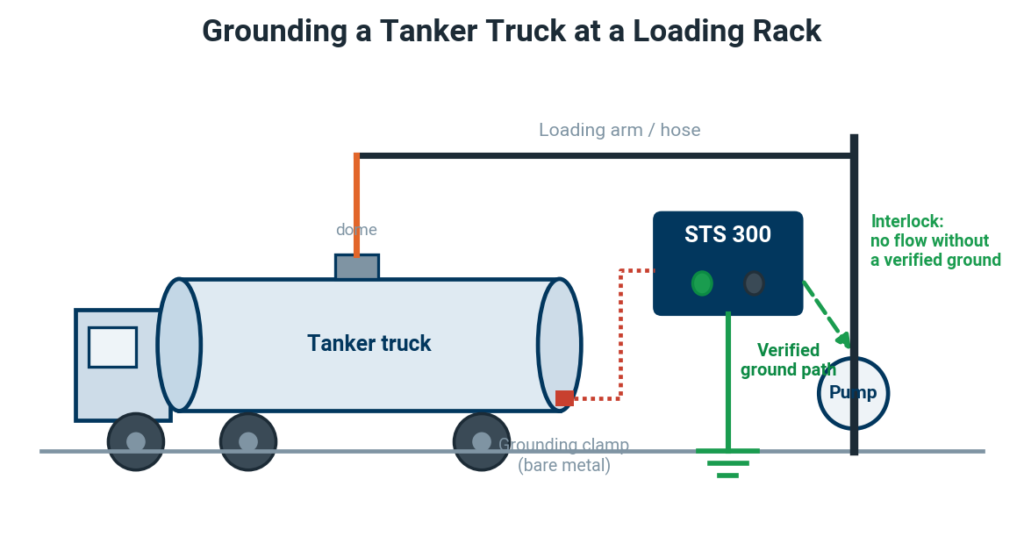
- Connect to a verified earth ground. Run the ground from the truck to a known-good earth grounding point at the rack, not to a random pipe or rail. All-metal paths should read below 10 ohms per NFPA 77.
- Verify before any product flows. Confirm the connection with a ground verification monitor before opening a dome, hatch, or valve. A clamp that looks connected is not proof that it is electrically sound.
- Interlock the operation. Where possible, tie the verified ground to the transfer system so the pump cannot start until a valid ground is confirmed. This removes the human-error step of starting flow on an unverified ground.
- Monitor continuously through the transfer. Static keeps generating as long as product flows, so a ground that drops mid-transfer is as dangerous as no ground at all. A monitored system stops the flow the moment it detects a fault.
- Disconnect in the correct order. When the transfer is complete, stop the flow first, close all product connections, allow residual charge to dissipate, then remove the ground last. Ground on first, ground off last, and never make or break the connection during active transfer.
Do Fuel and Tanker Trucks Need to Be Grounded?
Yes. Any tanker truck loading or unloading a flammable or combustible liquid should be bonded and grounded.
The reason is the flow itself. As product moves through hoses, pipes, and filters, it separates electrical charge, a process called flow electrification. An isolated truck can accumulate enough of that charge to produce an igniting spark. For the full mechanism, see how static electricity becomes an ignition source.
The requirement follows from that risk. OSHA expects ignition sources to be controlled during flammable-liquid transfer, and NFPA 77 and API RP 2003 treat bonding and grounding as the accepted control. It applies equally to fuel trucks, chemical tankers, and vacuum trucks.
What Are the Risks of Grounding a Truck the Wrong Way?
A wrong or unverified ground is more dangerous than an obvious one, because it hides the hazard behind a connection that looks fine.
A clamp on painted or rusted metal, or on a poor earth point, can carry far too much resistance to drain a charge while still appearing connected. A ground that passes at hookup can also work loose from vibration once the transfer starts.
In either case, the first sign of failure can be the spark itself. That is why the standard is verification, not just connection, and why a monitored system that checks the path continuously and interlocks the pump is the reliable answer.
How Do You Ground a Tanker Trailer Specifically?
A trailer follows the same sequence, with extra attention to isolation between the parts. The key points:
- Bond the trailer to the tractor and the rack so there is no potential difference between them.
- Ground the bonded assembly to earth, not just one component of it.
- Find bare, electrically continuous metal for the clamp on trailers with coatings or non-conductive parts.
- Verify the full path before loading, and keep it connected until flow has stopped and the charge has dissipated.
Which Standards Apply to Tanker Truck Grounding?
Four US references govern the practice. The full requirements are covered here; in brief:
| Standard | Scope |
| NFPA 77 | How to bond, ground, and verify a connection; the below-10-ohm guidance for all-metal paths |
| API RP 2003 | Foundational petroleum standard for loading-rack and tank-truck static, lightning, and stray-current protection |
| OSHA 29 CFR 1910.106 | Requires control of ignition sources during flammable-liquid handling and transfer |
| API RP 2219 | Applies specifically to vacuum trucks; references API RP 2003 for static protection |
Grounding a Tanker Truck the Reliable Way
The steps above prevent a static ignition only if the ground is real and stays real for the whole transfer, and a passive clamp cannot confirm either.
The STS 300 verifies the resistance of the ground path continuously against a 5-ohm setpoint, stricter than NFPA 77’s 10-ohm threshold, and interlocks the pump so loading cannot start or continue without a confirmed ground. It is used across fuel, chemical, and vacuum-truck operations, from jet-fuel fill stations to petroleum terminals.
To specify a system for your operation, see the STS 300 Ground Monitoring System or request a quote.
Frequently Asked Questions
How often should a truck’s ground be checked during a transfer?
Continuously. A charge builds the entire time product is flowing, so a one-time check at hookup does not tell you the ground held. A monitored system verifies the connection throughout and stops flow if it fails.
Can you ground a tanker truck to the loading rack instead of a ground rod?
Only if the rack itself is bonded to a verified earth ground. If the rack’s own ground is unknown or unverified, use a dedicated grounding point so you are not trusting an unproven path.
What resistance is acceptable for a truck ground?
For an all-metal path, NFPA 77 treats below 10 ohms as a sound connection. The STS 300 verifies against a stricter 5-ohm setpoint, so it flags a degrading ground before it reaches the standard’s limit.
Is bonding the same as grounding?
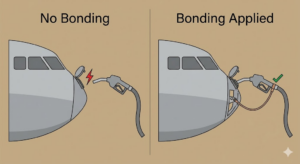
No. Bonding connects objects to each other so there is no voltage difference between them; grounding connects the bonded system to earth so the charge can dissipate. A safe transfer uses both.
Standards References
- NFPA 77, Recommended Practice on Static Electricity
- API RP 2003, Protection Against Ignitions Arising Out of Static, Lightning, and Stray Currents
- OSHA 29 CFR 1910.106, Flammable Liquids
- API RP 2219, Safe Operation of Vacuum Trucks