
Static Electricity in Chemical Processing: Hazards, Regulations, and How to Control Them
Static electricity builds up during every liquid transfer, powder movement, and filling operation in a chemical plant. The minimum ignition energy for many flammable vapors is less than 1 millijoule. A static spark that small is enough to ignite a vapor cloud near an open container or fill nozzle. NFPA 77 and OSHA 29 CFR 1910.106 require verified grounding and bonding at these facilities. Assuming a connection is intact does not meet those requirements. This guide covers how the hazard forms, what the regulations require, and what proper ground monitoring looks like in a chemical processing operation.
How Static Electricity Builds Up During Chemical Processing Operations
Static electricity forms when materials rub against surfaces or separate from one another during movement. Chemical plants create these conditions constantly, across multiple pieces of equipment and at every point in the transfer process.
Liquid Flow Through Pipes and Hoses
Liquid flowing through pipes and hoses generates electrostatic charges. Triboelectric charging is the process that generates electrostatic charge as liquids flow through pipes and hoses. Low-conductivity solvents like toluene, hexane, and petroleum distillates are especially prone to charge buildup. These liquids do not dissipate charge quickly as they flow, so charge accumulates on the liquid itself and on the walls of the pipe or hose. By the time liquid reaches a receiving container, the charge level can be high enough to produce a spark.
Powder and Granule Movement
Fine chemical powders and granules build up static charges as the material moves. Conveyor belts, blenders, and pneumatic transfer systems all create friction between particles and surfaces. This friction separates positive and negative charges. A charged powder cloud forms and can discharge as a spark when it comes near a grounded surface or a conductive object at a different potential.
Container Isolation
Drums, intermediate bulk containers (IBCs), and tanks can lose their connection to earth ground. Plastic linings, coatings, rubber gaskets, and painted surfaces all act as insulators. When a container is isolated from earth, charge builds up on it with no safe path to dissipate. Container isolation is why bonding between equipment and grounding to earth are both required, not optional.
Why Chemical Processing Facilities Face Higher Static Ignition Risk
Chemical plants work with flammable vapors and combustible dusts that ignite at a lower energy threshold than most other industries.
Low-Conductivity Liquids Hold Charge Longer
Petroleum solvents, toluene, hexane, and similar low-conductivity liquids do not conduct electricity well. Water dissipates static charges quickly as it flows. These solvents do not. Charge builds up on the liquid as it moves through pipes and hoses and stays there long after pumping stops. This makes every transfer operation a potential ignition risk, not just the moment of peak flow.
Combustible Dust Adds a Second Risk Category
Fine chemical powders present a different kind of static risk. A suspended dust cloud can ignite from a static spark just as a flammable vapor can. NFPA 660 (Standard for Combustible Dusts and Particulate Solids), which took effect in December 2024, addresses combustible dust hazards directly. Chemical plants that handle powders need to address vapor and dust ignition risks in their grounding programs, since the same transfer operations that generate vapor hazards can create dust hazards too.
Grounding and Bonding in Chemical Processing: What Each Does and Why Both Are Required
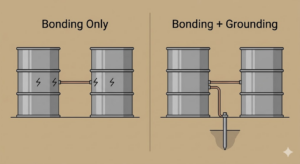
Safety managers sometimes use “grounding” and “bonding” as interchangeable terms. The two terms are not the same thing, and each one serves a distinct purpose.
| Term | Definition | Purpose |
| Bonding | Connecting two conductive surfaces so they share the same electrical potential | Prevents sparks when a fill nozzle approaches a container opening by equalizing potential between the two surfaces before contact |
| Grounding | Connecting equipment to earth through a grounding rod or grounding system | Gives accumulated charge a safe path to dissipate so it cannot build up to ignition levels |
A bonded system with no earth connection can still accumulate charge. The charge builds up on both pieces of equipment at the same level instead of sparking between them. So bonding without grounding does not fully protect against ignition.
NFPA 77 requires both bonding and grounding together. NFPA 77, the recommended practice on static electricity, treats a reading above roughly 10 ohms on an all-metal path as the sign of a compromised connection. A static charge itself drains through a much higher resistance, but a bond that should be metal-to-metal and measures well above 10 ohms usually has paint, rust, or product film in the joint. You can see how STS 300 ground monitoring systems verify this resistance in real time for chemical processing facilities.
Why Traditional Bonding Cables and Clamps Are Not Enough
A simple bonding cable and alligator clamp gives operators no feedback. A loose clamp looks the same as a secure one. A corroded cable looks the same as a clean one. Resistance can be far above 10 ohms, yet a visual inspection will not catch the problem.
Ground path failures often happen during operations, not before operations begin. A cable gets tugged. A clamp slips. Corrosion builds up overnight. These failures occur when liquid is flowing and vapor is present, which is the worst possible time for a ground connection to fail.
Surface coatings create another problem for clamps. Paint, epoxy linings, and powder coatings on tanks and drums act as insulators. A clamp resting on a painted surface may appear secure, but the jaw may not be making metal-to-metal contact. The connection provides no real grounding path in that condition. Clamps designed for coated surfaces use hard-wearing teeth to penetrate the coating and reach bare metal. The K78160A Grounding Clamp uses this design for reliable contact on painted and coated equipment.
NFPA 77 and OSHA require verified grounding. A cable hanging from a clamp does not meet that requirement on its own.
Grounding and Bonding Standards That Apply to Chemical Processing Facilities
Five standards govern static grounding in chemical processing facilities. EHS managers and compliance officers need to know which standards apply to their operations.
| Standard | Scope | Relevance to Chemical Processing |
| NFPA 77 | Recommended Practice on Static Electricity | Sets the 10-ohm resistance ceiling for grounding connections, bonding requirements during flammable liquid transfer, and inspection intervals for grounding equipment |
| OSHA 29 CFR 1910.106 | Flammable Liquids | Requires bonding and grounding during storage, handling, and dispensing of flammable liquids |
| NFPA 70 (National Electrical Code) | Class I Division 1 and Division 2 area classifications | Determines explosion-proof equipment ratings required for areas where flammable vapors are present under normal or abnormal conditions |
| NEMA 7, 8, and 9 | Explosion-proof enclosure ratings | NEMA 7 covers gas and vapor environments; NEMA 9 covers combustible dust environments; STS 300 Series systems carry all three ratings |
| API RP 2003 | Protection from ignition by static electricity, lightning, and stray currents | Referenced in petroleum-related chemical operations; principles apply broadly to any facility handling flammable liquids |
What Verified Static Grounding Looks Like in a Chemical Processing Operation
A verified grounding system monitors that connection continuously and shuts down operations when the connection fails.
The STS 300 Ground Monitoring System delivers these capabilities for chemical processing operations:
- Continuous resistance monitoring: The STS 300 checks resistance throughout the entire transfer operation. If resistance rises above 10 ohms or the cable loses continuity, the system stops pumping equipment before a discharge can occur.
- Automatic shutdown: The STS 300 handles resistance monitoring automatically, without operator input.
- Visual status confirmation: Green indicator lamps confirm the ground path is verified and safe. Red means the connection is absent. There is no guessing and no relying on a visual check of a cable.
- Fail-safe permissive control: Dry contact outputs connect to pumps, valves, and programmable logic controllers (PLCs), giving facilities fail-safe permissive control and helping demonstrate regulatory compliance during safety audits.
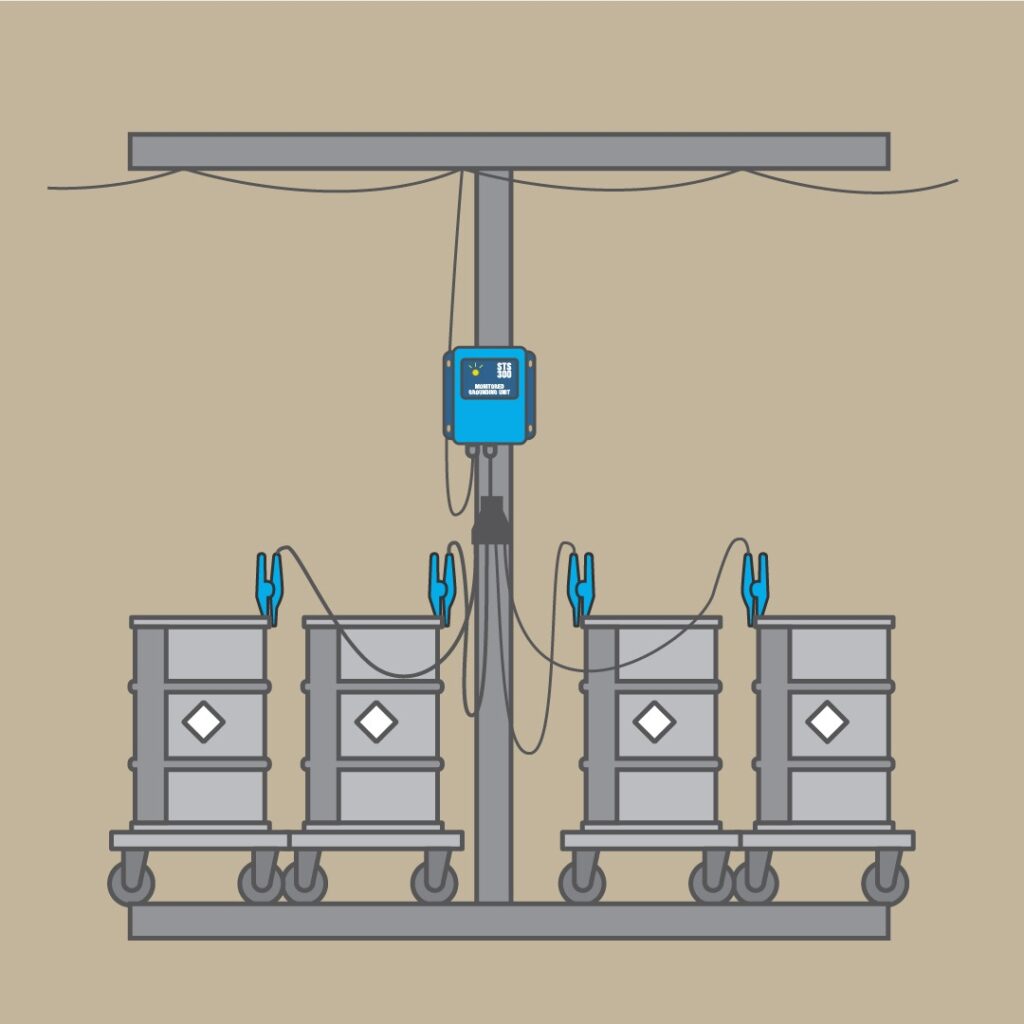
Facilities with multiple fill stations or several containers in use at once can use the STS 300 Multipoint Grounding System. This configuration monitors multiple ground connections from a single control unit, which reduces the number of units needed on a busy filling floor.
Common Questions About Static Grounding in Chemical Processing
What does NFPA 77 say about inspection frequency for grounding systems?
NFPA 77 recommends periodic visual inspection of grounding cables, clamps, and connections. Plant operators should use an ohmmeter to confirm continuity below 10 ohms. In high-risk settings, operators should confirm cable condition and clamp contact before each transfer. Facilities should keep records of these checks to support compliance documentation during audits.
What is the difference between Class I Division 1 and Division 2 environments?
Class I Division 1 locations have flammable vapors or gases present in hazardous concentrations during normal operations. Class I Division 2 locations have these vapors present only during abnormal conditions like a spill or equipment failure. Both require explosion-proof electrical equipment, but Division 1 carries stricter requirements. Grounding equipment must carry the enclosure rating that matches the area classification where it is installed.
Can static build up even when liquid flow is slow?
Yes. Charge accumulation depends on the conductivity of the liquid, not just the flow rate. Low-conductivity solvents like hexane or toluene build up charge at any flow rate. A slow fill does not eliminate the risk. Grounding and bonding are required throughout the entire operation, from the moment liquid starts moving to the moment the connection is broken.