
Static Electricity in Vacuum Truck Operations: Hazards, Regulations, and How to Protect Material Transfer Sites
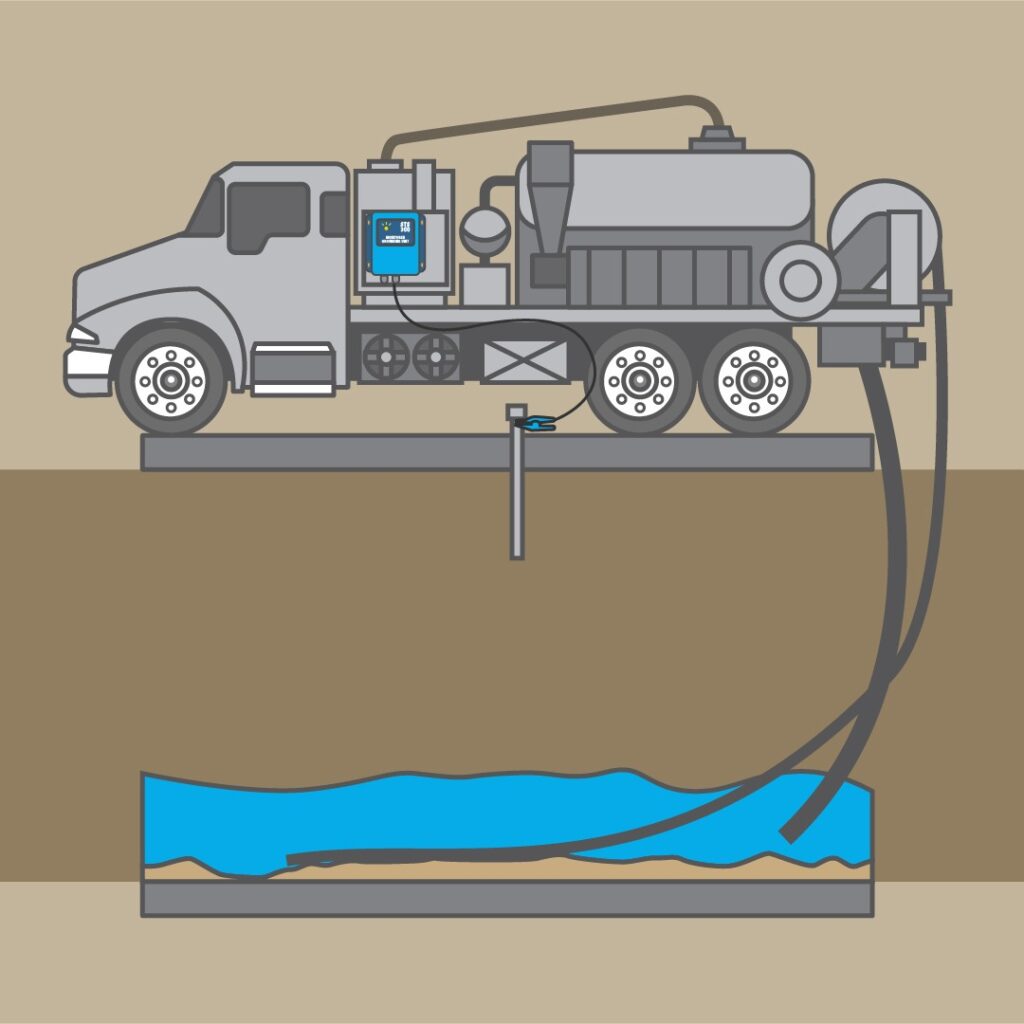
Vacuum trucks collect flammable liquids, sludges, and chemical residues through high-velocity suction. This process generates substantial electrostatic charge on the truck chassis, hoses, suction lance, and holding tank. These charges build up in environments where flammable vapors may already be present.
Vacuum trucks operate at remote job sites where permanent grounding infrastructure often does not exist. Rubber tires insulate the truck from the ground, so the vehicle cannot naturally dissipate the charge it accumulates. API Standard 2219 and NFPA 77 require verified grounding before any transfer begins. HSE officers and fleet safety managers who understand these risks can select grounding systems that meet API 2219 requirements and protect crews at every job site, regardless of how remote the location.
How Static Electricity Builds Up During Vacuum Truck Material Transfer
Friction between moving liquids and hose surfaces produces static electricity. Vacuum truck operations create several separate paths for charge to accumulate at the same time.
High-Velocity Suction Through Hoses
Vacuum trucks pull flammable liquids and slurries through hoses at high flow rates and high suction pressure. As liquid moves through the hose interior, friction between the fluid and the hose wall generates triboelectric charge. Corrugated hoses with textured inner surfaces generate more charge per unit of fluid than smooth-bore hoses. This charge accumulates on the hose itself, on the suction lance at the point of collection, and on any connected fitting that is not continuously bonded to a verified ground.
The Truck Chassis as an Isolated Conductor
The truck chassis is a large, electrically conductive structure. In a properly grounded installation, it provides a natural path for charge to flow to earth. Rubber tires change this situation entirely. The chassis rests on four non-conductive rubber surfaces, so charge that builds up anywhere on the system cannot drain to earth. The chassis becomes an isolated conductor capable of holding dangerous charge levels.
The Holding Tank Interior
Liquid entering the holding tank under suction continues generating charge as it splashes and flows inside the tank. The tank shell accumulates this charge. If the tank is not bonded to the grounded chassis, and the chassis is not connected to a verified earth ground, the tank can hold a significant charge separate from the rest of the truck system.
Why Vacuum Truck Operations Carry Especially High Static Ignition Risk
Three factors combine to make vacuum truck static ignition risk harder to control than at any fixed facility: the truck moves to uncontrolled sites, rubber tires prevent natural charge dissipation, and the materials collected produce flammable vapors at very low ignition thresholds.
The materials commonly collected by vacuum trucks include crude oil, fuel residues, and chemical solvents. These materials produce flammable vapors with minimum ignition energies as low as 0.25 millijoules, well below what a static spark from an ungrounded truck can generate. A static discharge that an operator would not feel as a shock can be enough to ignite an explosive atmosphere near the suction lance, hose connections, or vacuum breaker assembly.
Why Rubber Tires Cannot Be Relied On to Dissipate Static Charge
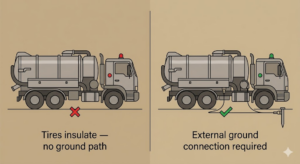
Many operators assume the truck’s contact with the ground through its tires provides some natural static protection. This assumption does not hold up under API Standard 2219.
Rubber tires are electrical insulators. Anti-static tires, which reduce static buildup from rolling friction, still do not provide the verified, low-resistance path to earth that API 2219 calls for. Industry practice, drawing on API 2219 and IEC 60079-32-1, uses 10 ohms as the monitoring threshold for the connection from the truck chassis to an earth ground point. No tire meets that threshold reliably.
Parking a truck on bare soil does not solve the problem. The rubber tire contact area is too small to dissipate the rate of charge accumulation produced by active high-velocity suction. Every vacuum truck job, regardless of surface or soil type, requires a dedicated external grounding connection from the truck chassis to a verified earth ground point before operations begin.
Grounding Vacuum Trucks at Remote and Uncontrolled Job Sites
Finding a verified ground point is the primary logistical challenge that separates vacuum truck static control from fixed-facility grounding. Fixed facilities like chemical plants and rail terminals have permanent grounding infrastructure built into the site. Vacuum trucks often arrive at locations with none of that.
A verified ground point is a connection to earth with resistance at or below the threshold the applicable standard requires. A metal stake driven into the ground without resistance testing does not qualify.
At sites with permanent infrastructure, operators should identify permanent grounding points, verified underground piping conduits, or structural steel with confirmed ground connections before work begins. These are the preferred options when available.
At sites without permanent infrastructure, operators can drive portable earth rods into the soil to create a temporary ground electrode. NFPA 77 notes that resistance up to 1,000 ohms is acceptable for the portable earth rod itself. API 2219 requires that the complete transfer system connection from the truck chassis to earth measure 10 ohms or less. Operators need to understand which threshold applies to which part of the system.
Soil conditions affect how well a portable earth rod performs. Dry, sandy, rocky, or frozen soil dramatically increases the resistance of a driven earth rod. At some remote locations, achieving adequate grounding with a single rod requires multiple rods, chemical ground enhancement compounds, or deeper installation. Resistance should always be measured after installation and before operations begin.
Bonding and Grounding for Vacuum Truck Operations: What Each Means and Why Both Are Necessary
Bonding and grounding are related but different. Getting bonding and grounding confused leads to incomplete protection.
| Bonding | Grounding | |
| What it means | Electrically connecting all conductive parts of the transfer system so they share the same electrical potential | Connecting the bonded system to a verified earth ground point |
| What it connects | Truck chassis, all hose lengths, suction lance, source vessel or collection point, and all fittings and adapters in between | The complete bonded assembly to a permanent ground point, verified underground piping, or a portable earth rod |
| What happens without it | Sparks can jump between system components that carry different charges when metal parts come close together or make contact | Accumulated charge cannot drain to earth. The entire bonded assembly remains collectively charged compared to surrounding structures and personnel |
API Standard 2219 identifies 10 ohms as the design target for new equipment connections from the truck chassis to earth. Industry monitoring systems use this figure to verify the ground path is intact throughout every transfer. STS 300 ground monitoring systems verify this resistance continuously throughout every vacuum truck transfer, not just at the start of the job.
Why Traditional Grounding Cables Cannot Protect Vacuum Truck Operations Alone
Passive grounding cables provide a connection. They do not verify that the connection is working. That distinction matters greatly in vacuum truck operations.
Cables used at mobile job sites get dragged across gravel, soil, spill debris, and rough industrial surfaces at every job. Clamps get dropped, stepped on, and knocked loose. Cable jackets crack. None of this damage is obvious when a clamp appears to be attached.
Truck chassis surfaces accumulate paint, rust, oil, and product residue over time. A clamp that is physically attached may not be making bare metal contact. Resistance rises without any visible sign of a problem.
A ground connection that passes a resistance check at the start of a job can degrade over a multi-hour operation as conditions change, connections shift, or components move during active suction. A single pre-job resistance check does not tell you what happens during the operation itself.
API 2219, NFPA 77, and OSHA regulations require documented grounding practices. A passive cable produces no record, so operators using passive cables cannot demonstrate compliance at audit. A continuous monitoring system logs ground path integrity for each operation, creating the documented record those standards require.
Static Grounding Standards and Regulations for Vacuum Truck Operations
Several standards govern static grounding for vacuum truck operations. HSE officers, fleet safety managers, and operations supervisors should be familiar with each one.
| Standard | What It Covers | Applies To |
| API Standard 2219 | Grounding and bonding requirements, 10-ohm design target, equipment inspection, and operational procedures for petroleum service | All vacuum truck operations collecting petroleum products, fuel residues, or flammable materials |
| NFPA 77 | Static control across all industrial contexts; guidance on temporary grounding with portable earth rods; 1,000-ohm allowance for temporary earth electrodes | Vacuum operations at facilities where NFPA standards are referenced |
| NFPA 70 (NEC) Class I, Div. 1/2, Groups C and D | Explosion-proof equipment requirements for locations where flammable vapors may be present | All monitoring and electrical equipment used at vacuum truck transfer sites |
| OSHA 1910.269 and 29 CFR 1910.106 | Electrical safety in hazardous operations and flammable liquids handling | Vacuum truck operations at facilities under OSHA jurisdiction |
| NEMA 7, 8, and 9 Enclosure Ratings | Hazardous location ratings for equipment used in environments where flammable vapors may be present | Equipment mounted on or used with vacuum trucks |
Verified, documented grounding means the ground path resistance was measured, met the applicable standard, and was recorded before operations began. Continuous monitoring goes further by verifying the path throughout the entire operation.
What Verified Static Ground Monitoring Looks Like in Practice for Vacuum Truck Operations
Passive cables show you that a connection was made. Verified ground monitoring shows you whether that connection is working at all times during the transfer.
For vacuum truck operations, a ground monitoring system needs to travel with the truck. A truck-mounted system brings verified monitoring capability to every job site, regardless of whether permanent infrastructure exists at that location.
- Continuous resistance monitoring. A truck-mounted ground monitoring system monitors resistance from the moment the grounding clamp attaches to a verified earth point through the end of the operation. If the connection fails or resistance rises above the threshold, the ground monitoring system responds at once.
- Permissive control integration. The ground monitoring system interfaces with the pump interlock controls on the truck. Transfer cannot begin until a verified ground path below 10 ohms is confirmed. If the connection fails during operations, the pump shuts down before a static discharge incident can occur.
- Visual status indication. Green confirms a verified ground path. Red signals a problem. Operators working near noisy, active equipment can check system status without instruments or manual testing.
- DC power compatibility. Truck-mounted systems run on 12V or 24V DC from the truck’s own battery system, not from a facility power grid.
- Cable management. Retractable cable reels keep cables organized and off the ground at active job sites, reducing trip hazards and protecting cables from damage between uses.
- Intrinsically safe signal circuits. For operations at refineries and chemical facilities classified as Class I, Division 1, monitoring systems require intrinsically safe signal circuits to meet hazardous location requirements.
Operational Factors That Shape Static Control in Vacuum Truck Operations
Vacuum trucks serve a wide range of job types. Three operations carry static hazards that deserve attention beyond standard petroleum collection.
Hydro Excavation Operations
Hydro excavation uses pressurized water to break up soil and vacuum suction to remove the resulting slurry. The slurry generates static charge differently than petroleum liquids. At petroleum-adjacent hydro excavation sites, such as locations near buried fuel lines or contaminated soil, explosive atmosphere conditions may still be present. Grounding requirements at these sites follow the same standards as other vacuum truck operations.
Tank Cleaning Operations
Vacuum trucks cleaning storage tanks collect concentrated residues, sludges, and heel materials from the bottoms of petroleum or chemical tanks. These materials may contain higher concentrations of flammable vapors than the original stored product. Grounding before any vacuum lance enters the tank is required under API 2219 and relevant confined space entry regulations.
Spill Response Operations
Emergency spill response adds time pressure to a situation where grounding procedures are most critical. Flammable product on the ground, in drainage channels, or in secondary containment creates explosive atmosphere conditions across a wide area. Portable earth rods, resistance testing, and pump interlocking are more important in emergency response than in routine operations, not less.
Common Questions About Static Grounding for Vacuum Truck Operations
What are the accepted grounding attachment points on a vacuum truck chassis?
Attach grounding clamps to bare, unpainted metal on the truck chassis. Acceptable points include unpainted structural steel on the frame, bare metal on the tank shell, or designated grounding lugs. Avoid painted surfaces, rubber components, and corroded metal. The K78160A grounding clamp uses hard-wearing teeth to penetrate light surface contamination.
Does the type of material being collected affect static charge generation?
Yes. Hydrocarbons with low electrical conductivity, such as refined fuels and clean solvents, generate more charge than water-based slurries at the same flow rate. High-viscosity sludges generate less charge than low-viscosity liquids. Regardless of material type, API 2219 requires grounding before any transfer of petroleum products or related flammable materials begins.
When should grounding be established during a vacuum truck operation?
Establish grounding before making any hose connections at the source vessel. Keep the ground path in place throughout the entire operation. Do not disconnect the ground until all hoses are removed and the transfer is complete.
How often should vacuum truck grounding cables and clamps be inspected?
Inspect cables and clamps before every job. Check for cracked jackets, damaged clamp jaws, worn teeth, and corroded terminations. API 2219 requires resistance testing before each loading or off-loading process. Remove any cable or clamp from service at once if it fails a resistance check or shows visible damage.
How do I know if a grounding cable is making a reliable connection?
Measure resistance. A cable that appears attached may not be making bare metal contact. Paint, rust, oil, and product residue raise resistance without any visible sign. A continuous ground monitoring system measures resistance throughout the entire operation and signals immediately when the connection degrades.
How do you test whether a ground connection meets the 10-ohm threshold?
Use a calibrated resistance meter to measure resistance from the truck chassis to the earth ground point. The reading should be 10 ohms or less. The K78160A grounding clamp uses hard-wearing teeth to produce reliable bare metal contact at the attachment point.