
Static Electricity in Aviation Fueling: Hazards, Regulations, and How to Protect Fuel Fill Stations
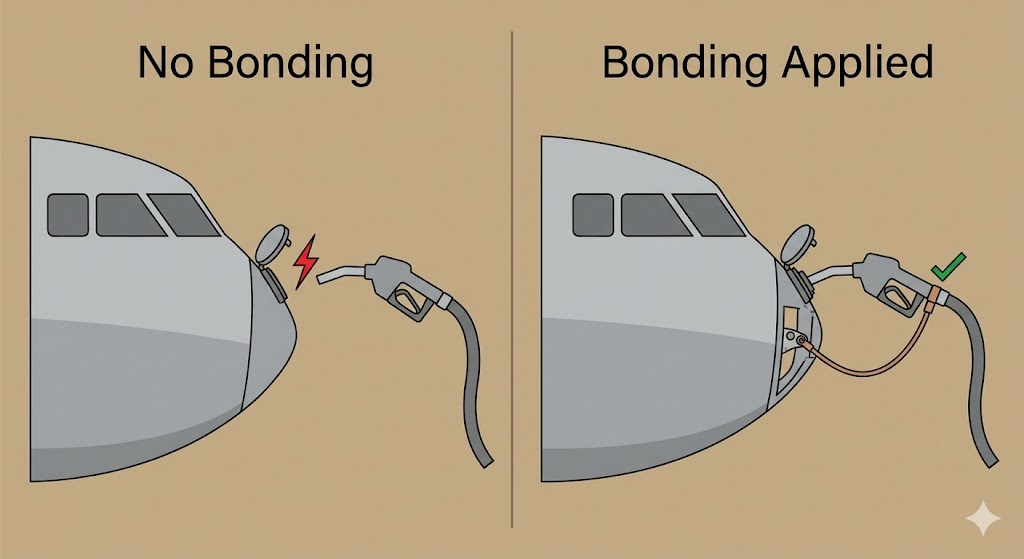
NFPA 407 does not require earth grounding during aircraft refueling. It prohibits it.
Section 5.4 of the standard states directly: “Grounding during aircraft fueling shall not be permitted.” Research by the Coordinating Research Council showed that when an aircraft and fuel truck are properly bonded to each other, a separate earth grounding wire carries no electrical charge. It adds no protection. What it does add is arcing risk at the moment the cable is connected or disconnected near open fuel tank vents.
The protection NFPA 407 requires is bonding. A bonding cable connects the fuel truck to the aircraft before the nozzle approaches the fuel cap. This equalizes the electrical potential between the two surfaces and prevents a spark at the point of contact. The bonding connection must stay in place throughout the entire transfer and must not exceed 25 ohms resistance.
Every aircraft refueling event generates static electricity through fuel flow, friction, and charge built up during flight. Jet-A produces flammable vapors at normal ambient temperatures. Those vapors ignite at extremely low energy thresholds. A static spark a person would not even feel carries enough energy to ignite them. Assuming a bonding cable is working does not meet NFPA 407’s verification requirements.
How Static Electricity Builds Up During Aircraft Fueling Operations
Static electricity forms when materials rub against surfaces or separate from one another during movement. Aviation fueling creates static-generating conditions through three distinct mechanisms, each one capable of generating enough charge to ignite fuel vapors near an open tank.
Fuel Flow Through Hoses and Nozzles
Triboelectric charging is the process that generates electrostatic charge as fuel moves at high velocity through dispensing hoses and nozzles. The faster fuel flows, the more charge builds up. High-speed pumping during peak operations at busy airports increases this risk. Jet-A aviation fuel has low electrical conductivity compared to water, so charge does not dissipate as fuel flows. Charge accumulates on the fuel itself and on the hose walls, reaching the nozzle tip as a potential ignition source near the fuel cap.
Aircraft as Isolated Conductors
Aircraft accumulate static electricity during flight from friction with air molecules and precipitation. Aircraft tires are made of conductive rubber and do dissipate some charge on landing, but the Goodyear Aviation tire care manual notes that this discharge rate is variable and not reliably controllable, so tires cannot be depended upon to fully dissipate accumulated charge. An aircraft arrives at a fill station still carrying residual static charge on its fuselage and fuel system components. Residual static charge remains on the aircraft until a bonding connection provides a path for equalization. A fuel nozzle approaching a charged fuel cap without prior bonding can produce a spark near open fuel tank vents.
Outdoor Fueling in Variable Conditions
Cold, dry air reduces the natural dissipation of static charge and increases charge buildup during fuel transfer. Remote airfields and high-altitude airports may have high-resistance soil conditions that limit earth ground effectiveness. Cold, dry air and high-resistance soil conditions do not create new hazards, but they compound the charge accumulation that occurs during every transfer operation. Static bonding monitoring equipment must carry enclosure ratings suited to outdoor installation across a wide operating temperature range.
Why Jet Fuel Vapor Ignition Risk Is So High at Fill Stations
Jet fuels produce flammable vapor mixtures within a specific concentration range, called the flammable range, between the Lower Explosive Limit and the Upper Explosive Limit. Normal ambient temperatures at fuel fill stations routinely fall within this range near open fuel caps. A static spark that a person would not even feel carries enough energy to ignite Jet-A vapors.
The Jet-A flash point is a minimum of 38 degrees Celsius per ASTM D1655. At many airports, ambient temperatures approach or exceed this threshold during warm months, keeping vapor generation active throughout operations. Fill stations do not need extreme conditions to face vapor ignition risk. The risk is present during every normal transfer event.
Bonding at Jet Fuel Fill Stations: What It Does and Why NFPA 407 Requires It
Safety personnel sometimes treat bonding and grounding as the same procedure. The two terms are not the same thing, and understanding the distinction matters for compliance.
| Term | Definition | Purpose |
| Bonding | Connecting the fuel truck or dispensing equipment to the aircraft with a cable | Equalizes the electrical potential between the two surfaces before the nozzle approaches the fuel cap, preventing a spark at the point of contact |
| Grounding | Connecting equipment to a verified earth ground through a grounding rod | Used in other industries to give accumulated charge a safe path to earth; not required and not permitted during aircraft fueling per NFPA 407 |
NFPA 407 requires bonding only. Since the 1990 edition, the standard has explicitly prohibited earth grounding during aircraft fueling. Research by the Coordinating Research Council demonstrated that when the aircraft and fuel truck are properly bonded to each other, a separate earth grounding wire carries no electrical charge. NFPA 407 Section 5.4 states: “Grounding during aircraft fueling shall not be permitted.”
The 25-ohm resistance ceiling in NFPA 407 applies to the bonding connection between the fuel truck and the aircraft. A bonding connection above 25 ohms does not reliably equalize potential between the two surfaces and creates a spark risk at the nozzle. STS 300 bonding monitoring systems verify this resistance throughout every fuel transfer at jet fuel fill stations.
Military aviation facilities handling JP-8 jet fuel follows the same bonding requirements as commercial operations. The same bonding procedure applies regardless of fuel type.
Why Traditional Bonding Cables Alone Are Not Sufficient for Aviation Fuel Servicing
A passive bonding cable and alligator clamp gives operators no feedback. A corroded clamp looks the same as a clean one. A loose connection looks the same as a secure one. Resistance can exceed 25 ohms, yet a visual inspection will not catch the problem.
Bonding connection failures often happen during operations, not before operations begin. A cable gets tugged by ground equipment. A clamp slips off a painted surface. Corrosion builds up on the clamp jaw overnight. These failures occur when fuel is flowing and vapor is present, which is the worst possible time for a bonding connection to fail.
Paint, oxidation, contamination, and worn clamp tips all increase resistance without obvious visual cues. A clamp resting on a painted surface may appear secure, but the jaw may not be making metal-to-metal contact. The K78160A Grounding Clamp uses hard-wearing carbide teeth to penetrate paint and surface contamination for reliable metal-to-metal contact at aircraft bonding points.
NFPA 407, ATA Specification 103, and FAA Advisory Circular 150/5230-4C all require documented verification of bonding, not assumed continuity. Passive bonding cables produce no documentation and provide no real-time confirmation that a bonding connection is intact.
Bonding and Compliance Standards for Aviation Fuel Servicing Operations
Five standards govern static bonding and equipment safety at jet fuel fill stations. Airport safety directors, FBO compliance officers, and ground handling managers need to know which standards apply to their operations.
| Standard | Scope | Relevance to Aviation Fueling |
| NFPA 407 | Standard for Aircraft Fuel Servicing | Primary standard; requires bonding between aircraft and fueling equipment; sets the 25-ohm resistance ceiling for the bonding connection; prohibits earth grounding during fueling; ATA Specification 103 inspection frequency recommendations align with NFPA 407 |
| NFPA 70 (National Electrical Code) | Class I, Division 1/2, Group D area classifications | Determines explosion-proof equipment ratings required for locations where flammable vapors are present; OSHA 29 CFR 1910.106 applies to flammable liquid handling operations at the same facilities |
| FAA Advisory Circular 150/5230-4C | Aircraft Fuel Storage, Handling, Training, and Dispensing on Airports | Covers bonding equipment requirements at commercial airports and documents the verification standards that airport operators must meet |
| API RP 2003 | Protection from ignition by static electricity, lightning, and stray currents | Referenced at aviation and petroleum fuel handling facilities; principles apply to any operation transferring flammable liquids |
| NEMA 7, 8, and 9 | Explosion-proof enclosure ratings | NEMA 7 covers gas and vapor environments at jet fuel stations; NEMA 9 covers combustible dust environments; STS 300 Series systems carry all three ratings for hazardous location installation |
What Verified Bonding Monitoring Looks Like in Practice at a Jet Fuel Station
A verified bonding system monitors the bonding connection continuously and stops fuel transfer when the connection fails.
The STS 300 Ground Monitoring System delivers these capabilities for aviation fuel fill station operations:
- Continuous resistance monitoring: The STS 300 checks bonding resistance throughout the entire fueling operation. If resistance rises above 25 ohms or the cable loses continuity, the system stops pumping equipment before a discharge can occur.
- Automatic shutdown: The STS 300 handles resistance monitoring automatically, without operator input.
- Visual status confirmation: Green indicator lamps confirm the bonding connection is verified and safe. Red means the connection is absent. Operators get a clear signal without checking a meter or inspecting a cable.
- Fail-safe permissive control: Dry contact outputs connect to pump controllers, valves, and programmable logic controllers (PLCs) already installed at fuel stations, giving facilities fail-safe permissive control and supporting compliance documentation during audits.
Fueling station layout and aircraft type determine which STS 300 configuration fits the operation. Light aircraft at FBO operations require shorter cable runs. Commercial ramp operations serving wide-body jets may need 50 to 125-foot cable lengths to reach aircraft bonding points from fixed equipment. Stations with multiple simultaneous fueling positions can use the STS 300 Multipoint Grounding System, which monitors multiple bonding connections from a single control unit.
Common Questions About Static Bonding in Aviation Fuel Servicing
What is the flash point of Jet-A fuel and why does it matter for static hazard?
At many airports, ambient temperatures approach or exceed the Jet-A fuel flash point threshold for much of the year. Jet-A fuel produces flammable vapor concentrations at normal operating temperatures, not just in extreme heat. Static bonding verification is a constant requirement at every fill event, not a seasonal precaution.
Why doesn’t landing on a runway discharge all static from an aircraft?
Aircraft tires are made of conductive rubber and do dissipate some charge on touchdown. The Goodyear Aviation tire care manual states that this discharge rate is variable and depends on tire surface cleanliness, atmospheric conditions, and runway surface. Tires cannot be depended upon to fully dissipate accumulated charge. The aircraft fuselage and fuel system components retain residual charge built up during flight. A bonding cable connection is required before any fueling equipment approaches the aircraft to equalize this residual charge before contact.
What does NFPA 407 say about inspection frequency for bonding cables?
NFPA 407 requires periodic inspection of bonding cables, clamps, and reels. Fueling operators should use an ohmmeter to confirm continuity below 25 ohms. Before each fueling operation, operators should confirm cables are undamaged and clamp jaws make clean metal-to-metal contact. Facilities should keep inspection records to support compliance documentation during audits by the local authority having jurisdiction.
What happens if fuel is transferred without bonding the aircraft to the fuel equipment?
Without a bonding connection, the aircraft and fuel truck may carry different electrical potentials. When the fuel nozzle approaches the aircraft fuel cap, the difference in potential can discharge as a spark. That spark occurs near open fuel tank vents where flammable vapor concentrations are at their highest. NFPA 407 requires bonding before any fueling equipment contacts the aircraft for this reason.
What is the difference between a bonding cable and a ground monitoring system?
A bonding cable is a passive conductor. It creates a physical connection between two surfaces but provides no feedback about whether that connection is intact or whether resistance is within safe limits. A ground monitoring system like the STS 300 actively checks bonding resistance throughout the entire fueling operation and has the ability to stops fuel transfer automatically if the connection fails. NFPA 407 and FAA Advisory Circular 150/5230-4C require verified bonding, and a passive bonding cable alone cannot produce that verification.