

Static Grounding and Bonding Standards: NFPA 77, NFPA 407 and API RP 2003

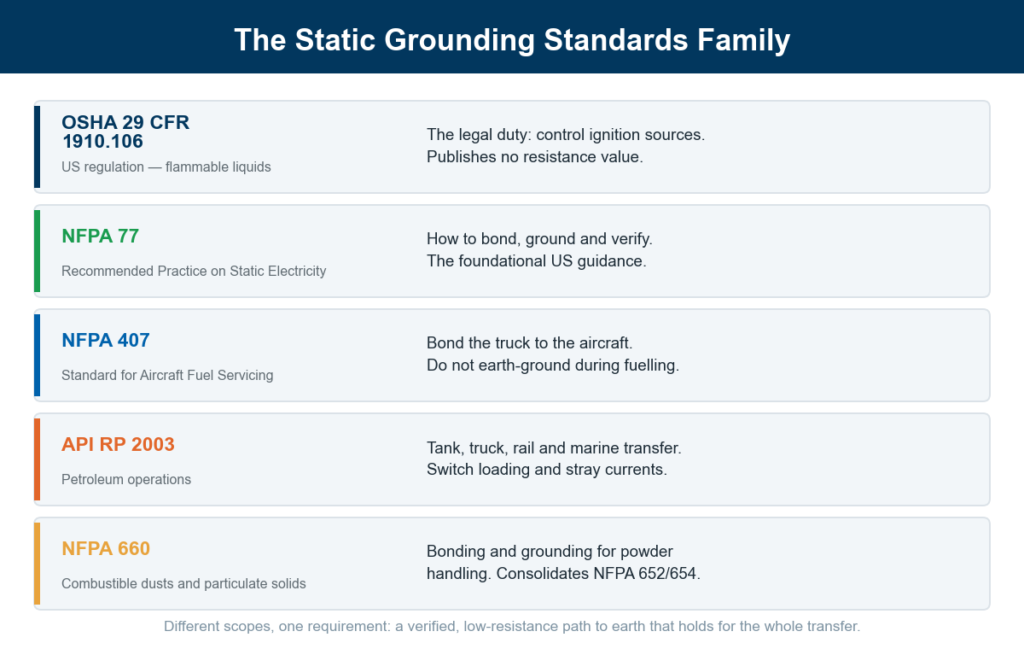
Static discharge is one of the leading ignition sources in flammable and combustible material transfer. A family of standards defines how to control it: NFPA 77 sets the foundational practice, NFPA 407 governs aircraft fueling, API RP 2003 covers petroleum facilities, and OSHA regulation makes controlling ignition sources a legal duty. This guide explains what each one requires, in plain English.
This is educational guidance, not legal or compliance advice. Always work from the current published edition of any standard and consult your authority having jurisdiction.
Grounding vs. Bonding: What Is the Difference?
Bonding connects two or more conductive objects to each other so they sit at the same electrical potential. If two drums are bonded, no voltage difference can build between them, so no spark can jump between them.
Grounding connects a conductive object to earth, giving accumulated charge somewhere to go.
They solve different halves of the same problem, and most transfer operations need both. Bonding removes the spark gap between objects. Grounding drains the charge out of the system entirely. Bonding two drums to each other and to nothing else leaves both of them charged; grounding one without bonding the other leaves a potential difference between them.
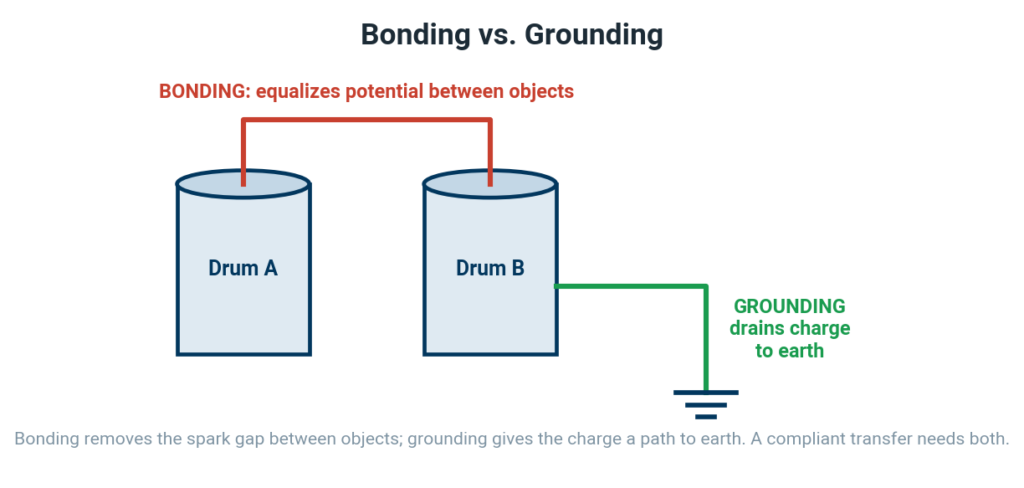
Every standard below is, at bottom, a set of instructions for doing these two things reliably and proving that you did.
NFPA 77: Recommended Practice on Static Electricity
NFPA 77 is the foundational document for static control in the United States. It explains how static charge is generated, how it accumulates, and what practices keep it from reaching an ignition threshold. It covers liquid flow, filtration, splash filling, powder handling, and human body charging.
The name matters: NFPA 77 is a recommended practice, not a code. It contains guidance rather than mandatory requirements, and adopting it is not itself a legal obligation. That distinction is narrower in practice than it sounds — see the OSHA section below.
What Resistance Is Acceptable for a Static Ground?
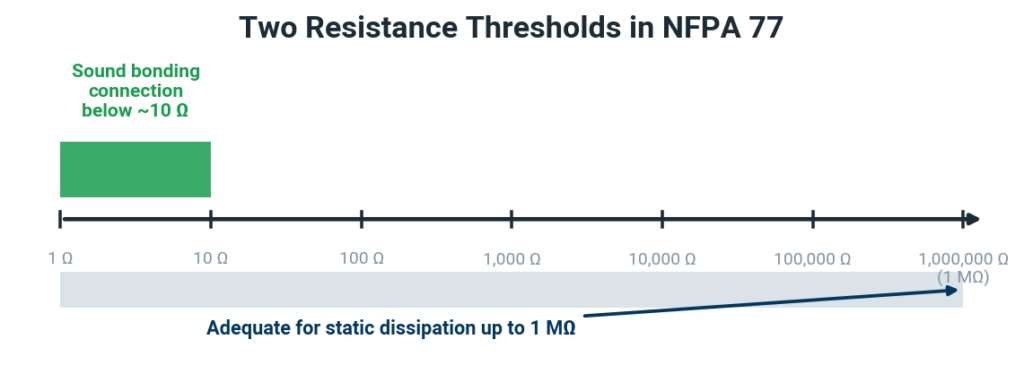
This is the number people search for, and the answer has two parts, because two different questions are being asked.
For draining static charge, a fairly high resistance is adequate. Charge dissipation does not require a heavy-current path — it requires a continuous one. Guidance in NFPA 77 treats resistance to ground on the order of 1 megohm (1,000,000 ohms) or less as sufficient to dissipate static.
For confirming a sound mechanical bond, the expectation is far tighter. A direct metal-to-metal connection between clean, bare surfaces should measure in the region of 10 ohms or less. A reading well above that on a connection that is supposed to be metal-to-metal usually means paint, rust, or product film in the joint, not a genuinely high-resistance path.
The practical implication: a system that verifies against a low single- or double-digit ohm setpoint is not being conservative for its own sake. It is checking that the physical connection is actually clean and tight, which is the failure mode that matters.
Why NFPA 77 Points Toward Continuous Verification
A resistance check at hookup tells you the connection was sound at the moment you tested it. It says nothing about the following ninety minutes.
The conditions that degrade a ground connection are exactly the conditions present during a transfer: vibration, thermal movement, tension on the cable, corrosion, and operators working around the clamp. A clamp can be knocked loose, a jaw can slip onto a painted surface, and a cable can part inside its jacket, with no visible sign in any case.
This is why the direction of travel in static control has been from passive bonding toward monitored, verified grounding: not because passive cables are useless, but because an unverified path provides no evidence that protection is still in place when it counts.
NFPA 407: Standard for Aircraft Fuel Servicing
Aviation is the case where the intuitive answer is the wrong one.
NFPA 407 requires bonding between the fuel servicing vehicle and the aircraft, it prohibits earth grounding of the aircraft during fueling. Research found that once an aircraft and fuel truck are properly bonded to one another, a separate earth ground carries no meaningful charge and adds no protection. What it does add is an arcing risk at the moment the cable is connected or disconnected, potentially near open fuel vents.
So the protection NFPA 407 requires is the bond: connect the truck to the aircraft before the nozzle approaches the fill point, maintain that bond for the entire transfer, and break it last.
Unlike NFPA 77, NFPA 407 is a standard, written in mandatory language and widely adopted by reference into airport operating requirements and insurer conditions.
STS builds grounding and bonding equipment for this application. See jet fuel fill station grounding systems, or the detailed guide to static electricity in aviation fueling.
API RP 2003: Protection Against Ignitions Arising Out of Static, Lightning and Stray Currents
API RP 2003 is the petroleum industry’s counterpart to NFPA 77. It addresses the same physics but is written around the operations petroleum facilities actually run: tank filling, truck and rail loading, marine transfer, switch loading, and tank cleaning.
Two areas where it earns its place alongside NFPA 77:
- Switch loading. Loading a low-conductivity product such as diesel into a compartment that previously held gasoline is one of the highest-risk operations in fuel distribution, because the vapor space may sit inside its flammable range while the incoming product generates charge.
- Stray and lightning currents. Cathodic protection systems, welding returns and induced currents can put current onto piping and equipment that has nothing to do with static, and the mitigation is different.
It is the reference to reach for at petroleum refining, oil rig, rail car loading and marine terminal operations.
Combustible Dust: NFPA 652, NFPA 654 and the Move to NFPA 660
Powders and particulate solids generate static too, and a dust deflagration does not need a liquid anywhere in the process. Bonding and grounding requirements for dust handling have historically sat in NFPA 652 (fundamentals) and NFPA 654 (particulate solids processing), alongside commodity-specific standards for agricultural dust, metals, and wood.
NFPA has consolidated that family into a single combustible dust standard, NFPA 660. If your dust hazard analysis or internal procedures still cite 652 and 654 by number, confirm which edition your AHJ and insurer are working from before your next review.
The grounding principle does not change. Conductive equipment in a dust handling train (hoppers, chutes, flexible connections, drums, filter housings, and the operator) needs to be bonded and grounded so charge cannot accumulate on an isolated conductor. See grain and powder processing and food and beverage applications.
Is Static Grounding Required by Law?
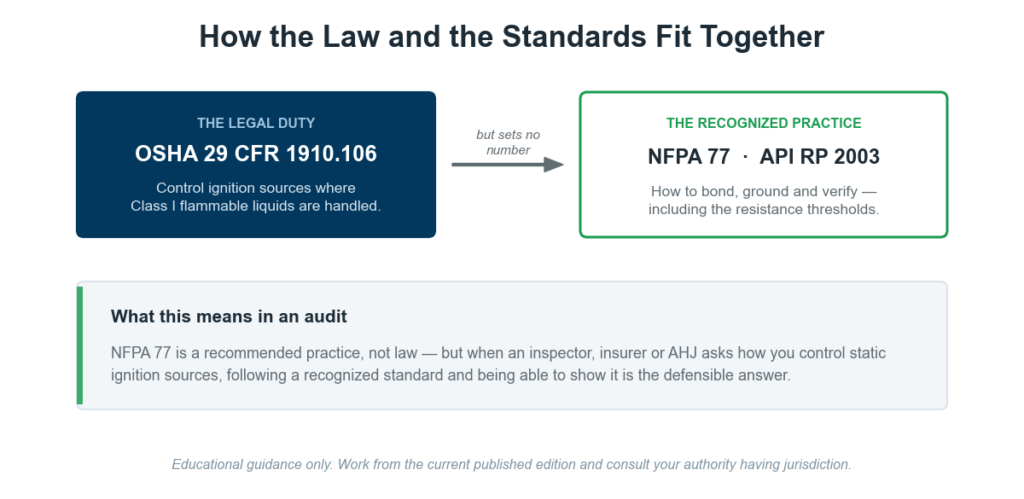
In the United States, the binding requirement comes from OSHA rather than from NFPA.
29 CFR 1910.106 governs flammable liquids and requires employers to control ignition sources where Class I flammable liquids are handled. Static electricity is one of those ignition sources. The regulation does not publish a resistance value, though it does mandate bonding in specific cases — for example, 29 CFR 1910.106(e)(6)(ii) requires that containers be electrically interconnected during dispensing of Category 1, 2, or lower-flashpoint Category 3 liquids. What it doesn’t do is define what resistance counts as a compliant connection.
That is the gap the consensus standards fill. When an inspector, insurer or auditor asks how you control static ignition sources, the defensible answer is that you follow a recognized practice — NFPA 77, or API RP 2003, or NFPA 407 for aviation — and can show that you do. This is why “NFPA 77 is only a recommended practice” is a thinner defence than it appears.
What These Standards Require of a Static Grounding System
Read together, the standards converge on five things a system has to do.
| Requirement | What it means in equipment terms |
|---|---|
| A defined resistance setpoint | The system judges the connection against a stated threshold, not against “the clamp is attached” |
| Continuous verification | The path is checked throughout the transfer, not once at hookup |
| Hazardous area rating | Enclosure and circuits rated for the classified area they sit in |
| Interlock or shutdown | Loss of a compliant ground stops the pump or closes the valve without operator intervention |
| Clear indication and record | Unambiguous operator status, and an output that can feed a control system or audit trail |
A passive cable and clamp satisfies the first half of the first row and none of the rest.
How STS Systems Meet These Standards
The STS 300 ground monitoring system was designed against that list. It verifies the ground path continuously against a resistance setpoint rather than confirming a connection once, drives a permissive interlock so pumping stops the moment a compliant ground is lost, is built for hazardous locations, and gives the operator unambiguous green/red indication with dry contacts for the control system.
If you are choosing between systems, the buyer’s comparison in our guide to static ground monitoring systems for flammable and combustible materials walks through what separates a dependable system from a false sense of security.
Frequently Asked Questions
What is the difference between grounding and bonding?
Bonding connects conductive objects to each other so they sit at the same electrical potential, removing the spark gap between them. Grounding connects an object to earth so accumulated charge can drain away. Most transfer operations need both.
What does NFPA 77 require for static grounding?
NFPA 77 is a recommended practice rather than a code. It sets out how static is generated and how to control it through bonding, grounding, flow-rate control and verification of connections. It is the reference US operations are generally measured against, even though adopting it is not itself a legal requirement.
What is the acceptable resistance for a static ground connection?
Two thresholds are in play. Resistance to ground on the order of 1 megohm or less is generally adequate to dissipate static charge. A direct metal-to-metal bond should measure far lower, in the region of 10 ohms or less; a higher reading on a connection that should be metal-to-metal usually indicates paint, rust or residue in the joint.
Is static grounding required by OSHA?
OSHA 29 CFR 1910.106 requires employers to control ignition sources where Class I flammable liquids are handled, and static electricity is one of those sources. OSHA requires bonding in certain dispensing operations but does not publish a resistance value, so operations demonstrate compliance by following a recognized consensus standard such as NFPA 77 or API RP 2003.
Which standard applies to aircraft fueling?
NFPA 407, the Standard for Aircraft Fuel Servicing. It requires bonding between the fuel servicing vehicle and the aircraft and prohibits earth grounding of the aircraft during fueling, because a separate earth ground adds arcing risk without adding protection once the bond is in place.
Not Sure Which Standard Applies to Your Operation?
STS has built static ground monitoring equipment in the United States since 1976, for operations working to every standard on this page. Tell us what you transfer and how, and we will tell you what the applicable standard expects of the equipment. Request a quote or contact us.