

How Static Electricity Becomes an Ignition Source in Hazardous Locations
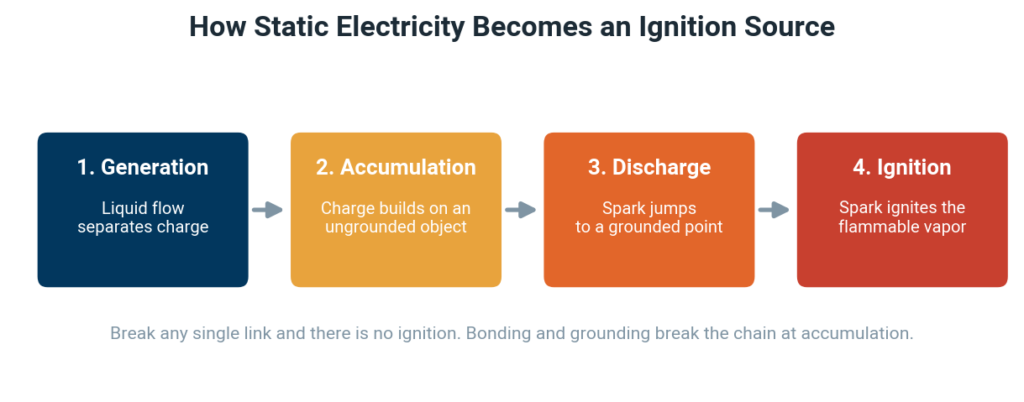
Static electricity becomes an ignition source through a four-step chain: charge is generated as liquid flows, it accumulates on an ungrounded object, it discharges as a spark, and if a flammable vapor is present in its flammable range, the spark ignites it.
In a hazardous location this can happen with an energy as small as a fraction of a millijoule, far less than a spark you could feel. That is why controlling static is central to flammable-liquid safety.
Understanding the chain is what makes the controls make sense. Break any single link and there is no ignition, which is exactly what bonding, grounding, and monitoring are designed to do.
The Four-Step Chain From Static Charge to Ignition
Here is how a harmless-seeming charge becomes a fire.
- Generation. When liquid flows through pipes and hoses, splashes into a tank, passes through a filter, or is stirred, electrical charge separates between the liquid and the surfaces it touches. This is called flow electrification, and faster flow or finer filtration generates more of it.
- Accumulation. The separated charge collects on any conductor that has no path to ground, an isolated drum, an ungrounded truck, or even a person in insulating footwear. Without a route to earth, the voltage climbs.
- Discharge. Once the accumulated voltage is high enough, the charge jumps the gap to a nearby grounded object as a spark, releasing its energy in a tiny fraction of a second.
- Ignition. If a flammable vapor is present in the air within its flammable range, and the spark carries more than the vapor’s minimum ignition energy, the vapor ignites.
What Generates Static Electricity During Liquid Transfer?
The main source is the flow itself.
As a nonconductive or low-conductivity liquid moves through piping, hoses, and filters, charge separates at every surface it contacts. This is flow electrification, and the liquid carries that charge into the receiving container, where it accumulates if there is no path to ground.
Several conditions increase how much charge is generated: splash filling that lets liquid free-fall into a tank, fine filtration, high flow rates, and a second phase such as water droplets or air bubbles suspended in the liquid.
What Three Conditions Must Exist for a Static Ignition?
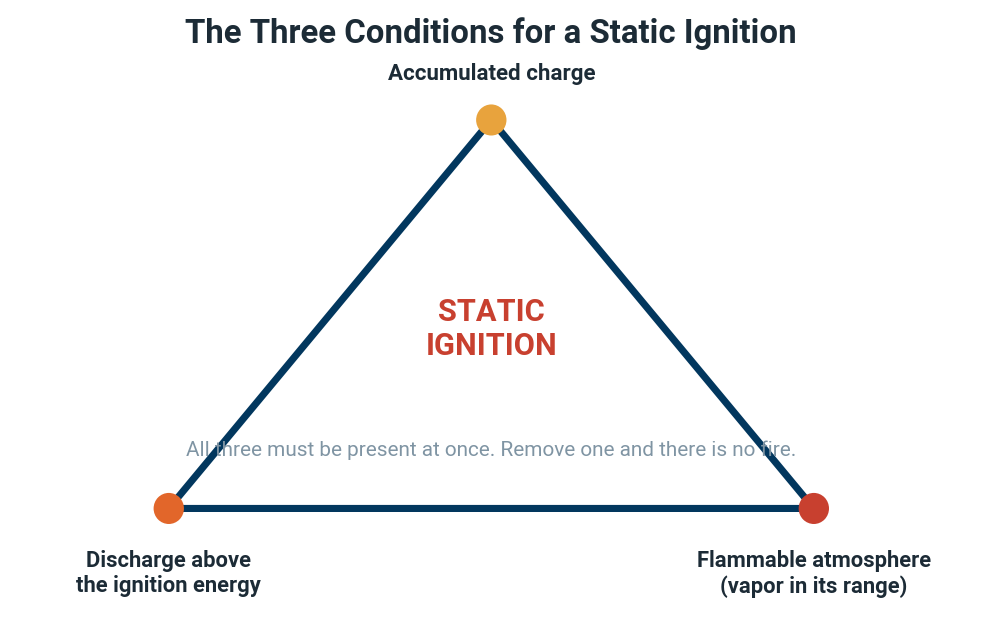
A static ignition needs all three of the following at the same time. Remove any one and it cannot happen.
- An accumulated charge on an ungrounded, isolated conductor.
- A discharge energetic enough to ignite, meaning a spark above the vapor’s minimum ignition energy.
- A flammable atmosphere, meaning vapor in air within its flammable range, between the lower and upper explosive limits.
The flammable range is narrower than most people expect. Gasoline vapor, for example, ignites in air only between about 1.2 and 7.6 percent by volume. Below that the mixture is too lean to burn, and above it too rich. That is why a spill can still be dangerous even when the air does not smell strongly of fuel.
For most hydrocarbon vapors the minimum ignition energy is only about 0.25 millijoule, compared with roughly 20 millijoules for a spark you can feel. That is why a discharge far too small to notice can still start a fire.
Where Does Static Ignition Happen in a Facility?
It happens anywhere flammable liquid is transferred and a charge can accumulate. Common points include:
- Loading and unloading tank trucks and rail cars
- Filling drums and IBCs, and charging reactors
- Sampling, gauging, and vacuum-truck operations
- Aviation fueling and marine terminal transfers
The common thread is a transfer that generates charge and an object that is not reliably grounded. Chemical processing, petroleum refining, and grain and powder handling all share the same mechanism, which is why the same control applies across them.
How Do You Prevent a Static Ignition?
You break the chain at the accumulation step, before a charge can build to a discharge.
Bonding connects conductive objects so there is no voltage difference between them, and grounding gives the accumulated charge a path to earth so it dissipates as fast as it forms.
Because a connection that is not maintained is no protection, the reliable approach verifies the ground continuously and stops the transfer if it fails. That is the difference between assuming a ground and proving one. The requirements behind the practice set out exactly what a compliant connection looks like.
Controlling the Ignition Source
The whole point of bonding, grounding, and monitoring is to break this chain before it starts. Every static ground monitoring system exists to keep a charge from ever reaching the discharge step.
To put this into practice, see how to ground a tanker truck step by step, or see how continuous verification works with the STS 300 Ground Monitoring System. To discuss your application, request a quote.
Frequently Asked Questions
Can static electricity really start a fire?
Yes. A spark far too small to feel can ignite a flammable atmosphere. For most hydrocarbon vapors the minimum ignition energy is about 0.25 millijoule, while a spark you can feel is roughly 20 millijoules, so the danger is well below the threshold of notice.
What is minimum ignition energy?
It is the smallest amount of spark energy that can ignite a given vapor at its most easily ignitable concentration. For common hydrocarbons it is around 0.25 millijoule, which is why static discharges are treated as a real ignition source in flammable atmospheres.
Does grounding eliminate static electricity?
No. Grounding does not stop a charge from being generated by flow. It gives the charge a safe path to earth so it dissipates as fast as it forms, instead of accumulating on an isolated object until it discharges as a spark.
Can a person be a static ignition source?
Yes. A person in insulating footwear can accumulate a charge and produce an igniting spark, which is why personnel grounding and dissipative footwear matter in hazardous areas alongside equipment grounding.
Standards References
- NFPA 77, Recommended Practice on Static Electricity
- OSHA 29 CFR 1910.106, Flammable Liquids